Fascia (Latin: fascia)
Overview
- Narrow sense
- Superficial fascia : a layer of loose connective tissue just under the skin, often containing fat. ≈ subcutaneous tissue (Terminologia Anatomica uses this name rather than fascia).
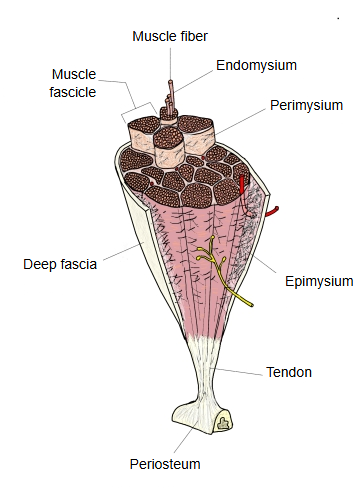
- Deep fascia : a dense connective tissue sheet that wraps muscles and groups of muscles directly, such as the pectoral fascia and the fascia lata; inside it lie the epimysium, perimysium and endomysium of the muscle itself.
- Wider sense : fasciae that wrap organs, vessels and nerves, e.g. the carotid sheath, the pretracheal layer of the cervical fascia and the renal fascia.
Whether fascia is generally divided into narrow and wide senses is not clear; some sources count the fasciae around the organs as a kind of superficial fascia. Usage also differs: older texts limited fascia to the sheath of a muscle, while current usage treats it as any dissectible sheet of connective tissue.
· All of these layers lie between the skin and the bones and muscles. They hold structures in place, let them glide on each other and carry vessels and nerves.
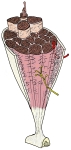 Layers of connective tissue in a muscle
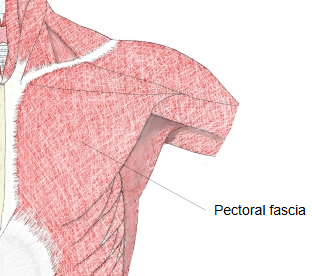
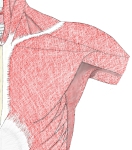 Pectoral fascia
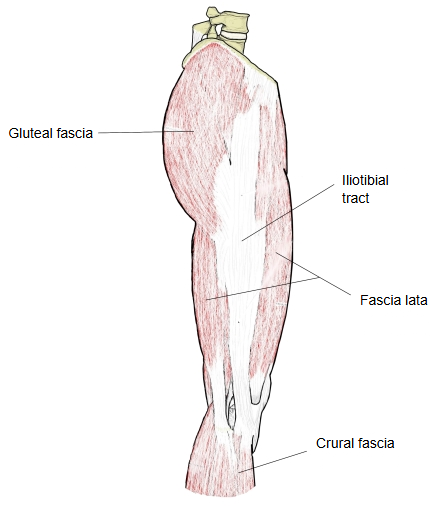
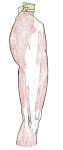 Fasciae of the thigh
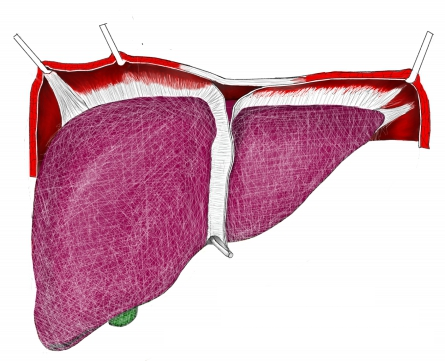
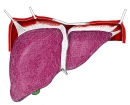 Liver and its fibrous capsule
Fascia around the organs
Terms such as "visceral fascia" or "organ fascia" are sometimes used, but they are not official anatomical terms.
The standard terminology has no single name for these layers; they are usually described as serous membranes, organ capsules or interstitial connective tissue.
· They are basically connective tissue, but their nature differs from organ to organ.
Lungs, intestines and others: serous membrane (mesothelium + basement membrane + a thin layer of connective tissue). Organs covered by peritoneum or pleura are wrapped by a serous membrane, which is a different tissue from fascia.
Kidney, liver and others: a fibrous capsule (dense connective tissue).
Character: more varied from organ to organ than the superficial and deep fasciae. Some are elastic and mobile; others are strong and protect the organ.
Role: protecting and fixing the organs and reducing friction; providing routes for vessels and nerves.
Examples
| Organ | Layer | Description | |
|---|---|---|---|
| 1 | Kidney and suprarenal gland | Renal fascia | A connective tissue membrane that encloses both the kidney and the suprarenal gland, outside the fibrous capsule |
| Renal capsule | The thin fibrous membrane covering the kidney itself | ||
| 2 | Liver and gallbladder | Fibrous capsule of the liver | A thin fibrous capsule over the whole liver; it continues inward around the vessels and bile ducts as the perivascular fibrous capsule (Glisson's capsule) |
| Wall of the gallbladder | A fibrous layer covering the gallbladder, attached to the liver capsule where the gallbladder lies against the liver | ||
| 3 | Pancreas | Thin connective tissue | No true capsule; a thin layer of connective tissue, held in the retroperitoneum and continuous with the connective tissue around it (sources differ on how it is named) |
| 4 | Heart | Pericardium | Fibrous pericardium: the tough outer sac, with fascia-like properties. Serous pericardium: the inner layers, a serous membrane, not fascia |
| 5 | Spleen | Splenic capsule | A fibrous membrane covering the organ; it supports and protects the vessels |
| 6 | Others | Capsule of the ovary | Tunica albuginea of the ovary, a fibrous layer under the surface epithelium |
| Capsule of the testis | Tunica albuginea of the testis, a thick fibrous capsule | ||
| Connective tissue around the prostate | Prostatic capsule and fascia | ||
| Parts of the stomach, small and large intestines | Covered by peritoneum, but some parts have connective tissue layers with fascia-like properties |
Sources differ on whether organ capsules (liver, kidney, spleen) should be counted as fascia.
Related terms
- Muscle
- Endomysium
- Thoracolumbar fascia
- Pectoral fascia
- Cervical fascia
- Transversalis fascia
- Renal fascia
- Parietal pelvic fascia
- Fibrous pericardium
- Tendon
References and sources
- Further reading: Fascia, Wikipedia.
- Further reading: Deep fascia, Wikipedia.
- Federative International Programme for Anatomical Terminology (FIPAT). Terminologia Anatomica, 2nd ed. (TA2), 2019.