Prerectal fibers (Latin: fibrae prerectales)
Also called the prerectal fibres of levator ani
The name is found in some detailed descriptions of levator ani and in some atlas figures of the pelvic floor ('prerectal fibers'), but many textbooks do not use it.
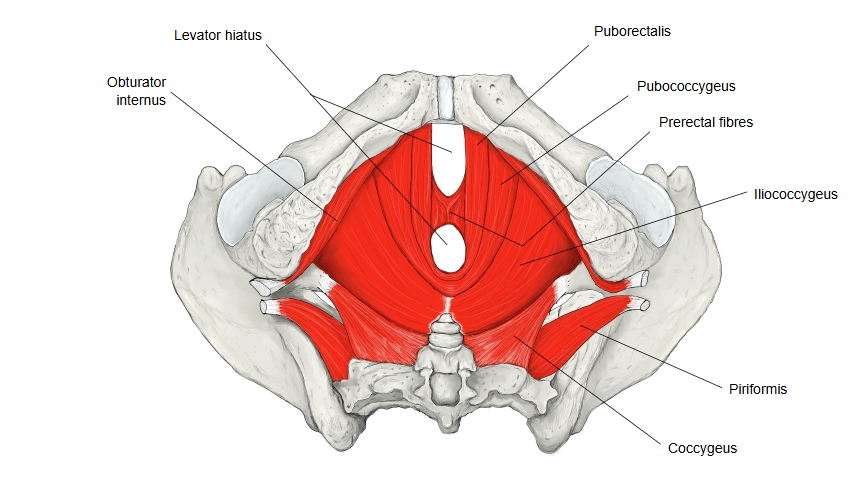
The strong anterior part of levator ani, pubococcygeus, arises from the inner surface of the pubis just below the pelvic brim; the thin posterior part, iliococcygeus, arises from the tendinous arch of levator ani and the ischial spine. The origin blends with the fascia of obturator internus (obturator fascia) and is strengthened by the tendinous arch of levator ani. On each side the medial fibres of pubococcygeus form the levator crura, which border the levator hiatus. They run backwards and downwards, passing lateral to and in front of the rectum, and divide into the thin prerectal fibres, which spread into the perineal body (central tendon of the perineum), and the fibres to the prostatic fascia (levator prostatae) or, in the female, to the wall of the vagina (pubovaginalis). The fibres behind them pass round the back of the rectum as puborectalis, forming a loop with those of the other side. The lateral fibres of pubococcygeus and the fibres of iliococcygeus attach to the coccyx and sacrum and, between the anus and the coccyx, to the anococcygeal body (anococcygeal ligament).
Related terms
- Levator ani
- Pubococcygeus
- Puborectalis
- Levator hiatus
- Perineal body
- Pelvic diaphragm
- Tendinous arch of levator ani
References and sources
- Further reading: Levator ani, Wikipedia.
- Federative International Programme for Anatomical Terminology (FIPAT). Terminologia Anatomica, 2nd ed. (TA2), 2019.