Afferent arteriole (Latin: arteriola glomerularis afferens)
Also called the afferent glomerular arteriole
Overview
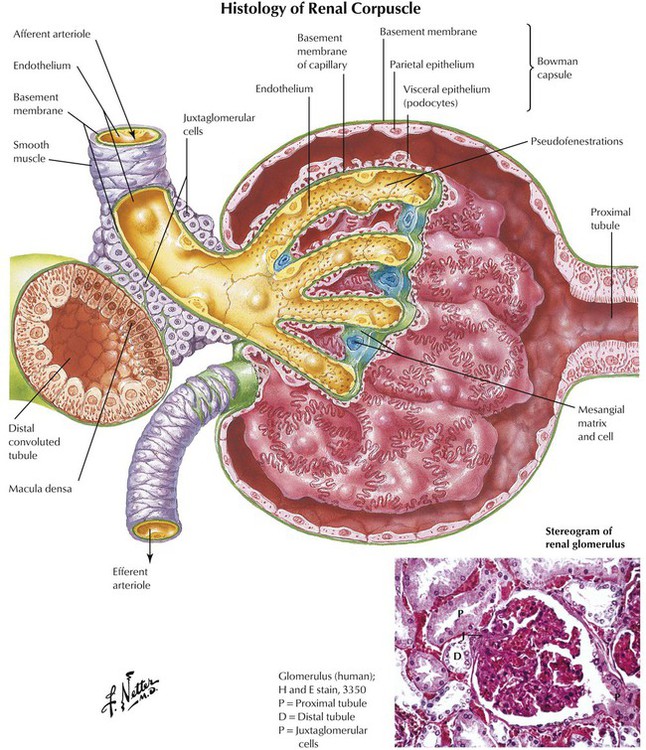
· The afferent arteriole is the arteriole that branches from an interlobular artery (cortical radiate artery), enters the renal corpuscle at the vascular pole and divides into the capillaries of the glomerulus.
· Inside the corpuscle it breaks up into the glomerular capillaries, which form the glomerulus. These capillaries join again into a single efferent arteriole, which leaves the glomerulus at the same vascular pole.
· The afferent arteriole is wider than the efferent arteriole; this difference in width helps to build up the pressure inside the glomerulus (the filtration pressure).
· Near the vascular pole its wall contains the juxtaglomerular cells, modified smooth muscle cells that secrete renin. Together with the macula densa of the distal tubule and the extraglomerular mesangial cells, they form the juxtaglomerular apparatus.
· When blood pressure or renal blood flow falls, the juxtaglomerular cells secrete renin, and the renin–angiotensin–aldosterone system raises the blood pressure.
· By constricting and dilating, the afferent arteriole adjusts the amount of blood flowing into the glomerulus and so the glomerular filtration rate.
Reference websites
[Wikipedia]
· Afferent arterioles, Wikipedia.
· Efferent arteriole, Wikipedia.
[Websites with illustrations]
· Glomerular filtration (University of Chicago Kidney Stone Program)
· Renal corpuscle (2D functional tissue unit) (Human Reference Atlas)
· Histology of the renal corpuscle (illustration) (Basicmedical Key)
Related terms
- Glomerulus
- Glomerular capillary
- Renal corpuscle
- Vascular pole
- Juxtaglomerular cells
- Juxtaglomerular apparatus
References and sources
- Further reading: Afferent arterioles, Wikipedia.
- Federative International Programme for Anatomical Terminology (FIPAT). Terminologia Anatomica, 2nd ed. (TA2), 2019.