Costotransverse joint (Latin: articulatio costotransversaria)
What is the costotransverse joint?
The costotransverse joint is one of the joints between the thoracic vertebrae and the ribs (the costovertebral joints, together with the joint of head of rib). It is the joint between the articular facet of the tubercle of rib (the tubercle is a swelling at the lateral end of the neck of rib) of the 1st to 10th ribs and the transverse costal facet on the transverse process of the thoracic vertebra of the same number.
- The joint capsule is thin and loose.
- The 11th and 12th ribs have no costotransverse joint; their necks are joined to the transverse processes only by ligaments.
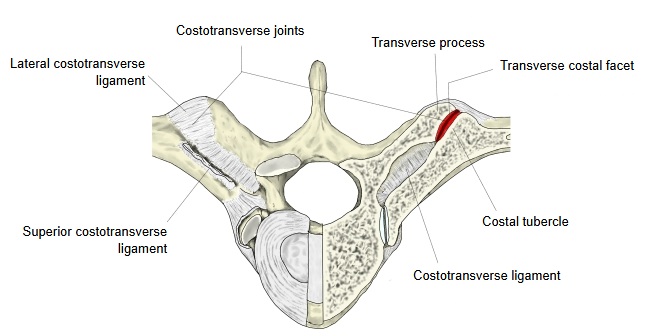
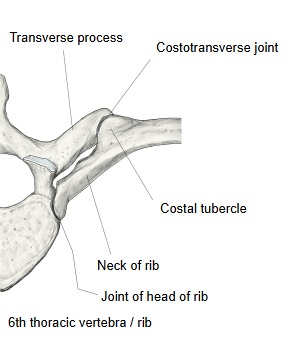
Bones
Costotransverse joint: 1st to 10th ribs (tubercle of rib, articular facet) ⇔ 1st to 10th thoracic vertebrae (transverse process, transverse costal facet)
The articular surfaces face at about 45° to the sagittal plane in the upper thoracic region and turn closer to the sagittal plane further down.
Ligaments
| Ligament | Notes | |
|---|---|---|
| 1 | Costotransverse ligament | Fills the space between the neck of the rib and the transverse process of the same vertebra. |
| 2 | Lateral costotransverse ligament | Runs from the tip of the transverse process to the non-articular part of the tubercle of the rib. |
| 3 | Superior costotransverse ligament | Runs from the neck of the rib up to the transverse process of the vertebra above. The dorsal (posterior) ramus of the spinal nerve passes behind it, and the intercostal nerve in front of it. |
| 4 | Lumbocostal ligament | Runs from the 12th rib to the costal processes of the 1st and 2nd lumbar vertebrae. |
More about the joint
The costotransverse joint is a synovial gliding joint. Working together with the joint of the head of the rib, these two posterior joints let each rib rotate about the axis of its neck, so that the ribs move up and down in parallel during breathing.