Cricothyroid joint (Latin: articulatio cricothyroidea)
What is the cricothyroid joint?
Three types of cricothyroid joint have been described:
| Type | Frequency | Features | Range of movement |
|---|---|---|---|
| A | 66% of men, 56% of women | A clearly defined articular facet and a tight joint capsule. | About 3.0 mm horizontal and 2.5 mm vertical (greater in women than in men) |
| B | 20% of men, 24% of women | No clearly defined facet; the two cartilages are joined only by soft connective tissue. | About 5 mm both horizontally and vertically |
| C | The rest | The articular surface is nearly flat, sometimes with a tiny bump. | About 5.1 mm horizontal and 3.8 mm vertical |
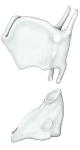 Cricothyroid joint
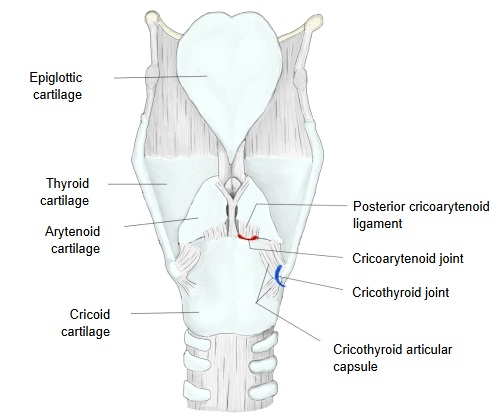
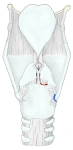 Joints of the larynx 1 (posterior view)
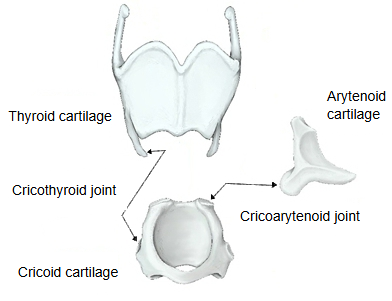
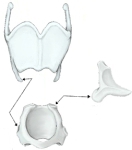 Joints of the larynx 2
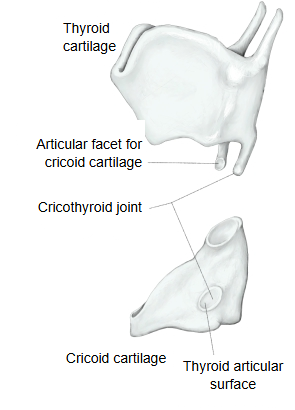
More about the joint
The cricothyroid joint connects the cricoid cartilage and the thyroid cartilage and plays a key part in adjusting the pitch of the voice by changing the tension of the vocal cords. This tension is controlled mainly by the vocalis inside the larynx and the cricothyroid muscle outside it. The cricothyroid muscle narrows the space between the two cartilages through rotating and gliding movements, in horizontal and vertical directions, that the joint allows.
In type A the facet is either concave or has a small groove running from back and above to front and below, and the joint is held by a tight capsule and ligaments; it moves more horizontally than vertically. In type B the horizontal and vertical movements are about equal. Type A is the least mobile of the three types.