Lateral atlanto-axial joint (Latin: articulatio atlantoaxialis lateralis)
What is the lateral atlanto-axial joint?
- Median atlanto-axial joint : anterior arch of the atlas and the dens of the axis; pivot joint
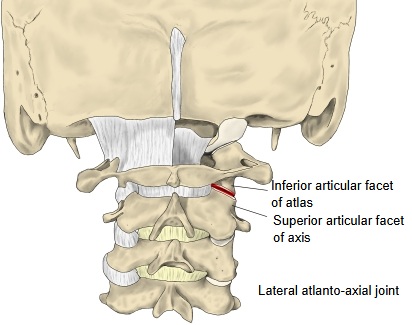
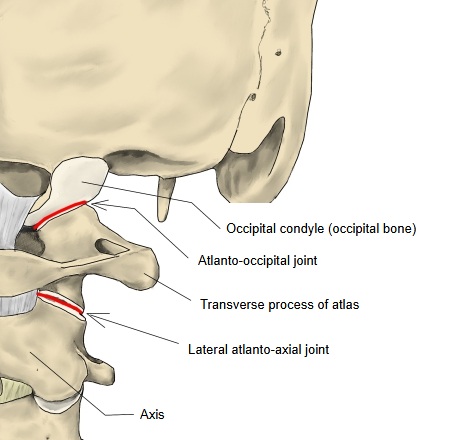
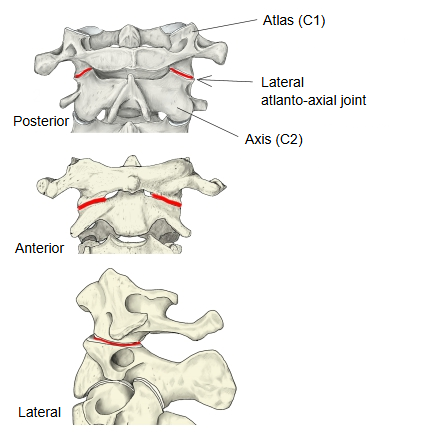
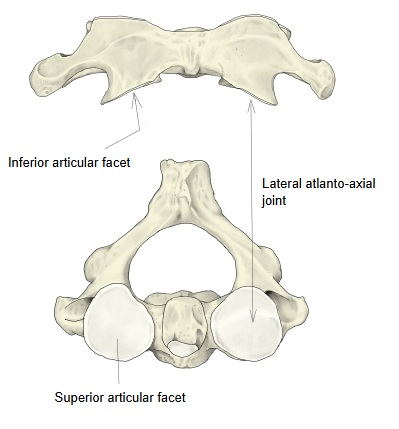
- Lateral atlanto-axial joint : inferior articular facets of the atlas and superior articular facets of the axis; nearly a plane joint
The main facts about the lateral atlanto-axial joint are:
- It is enclosed in a loose, wide joint capsule. The joints of the two sides work together to rotate the atlas, which carries the skull.
- The articular surfaces are not always fully covered with articular cartilage.
- When covered with articular cartilage, both the upper and the lower articular surface are slightly raised in the middle and lower in front and behind, and as a whole they slope downwards towards the side.
Bones
More about the joint
The lateral atlanto-axial joint lies between the inferior articular facet of the atlas and the superior articular facet of the axis, and is close to a plane joint. It is enclosed in a loose, wide capsule, and the joints of both sides work together to rotate the atlas, carrying the skull, around the dens. When the surfaces are covered with articular cartilage, both the upper and the lower surface are slightly raised in the middle and lower in front and behind, and slope downwards and outwards as a whole. The joint surfaces can therefore be seen as parts of a cone that opens downwards, with its tip at the base of the dens. This is the reverse of the atlanto-occipital joint, whose sockets on the atlas can be seen as parts of a bowl-shaped hollow that opens upwards.