Metabolic syndrome
Also called the visceral fat syndrome
Also called visceral fat syndrome. A state in which visceral (abdominal) obesity is combined with two or more of high blood pressure, high blood glucose and dyslipidaemia (abnormal blood lipids, formerly called hyperlipidaemia).
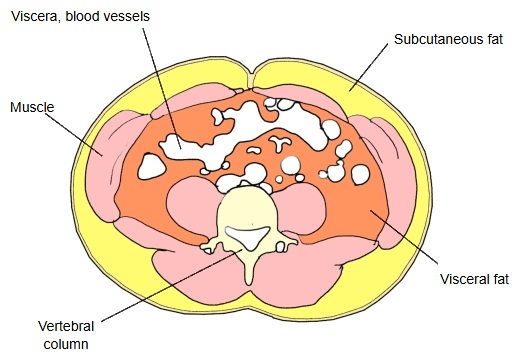
More details
'Metabolic' means 'of metabolism' and 'syndrome' means a group of signs that occur together. Over time metabolic syndrome leads to atherosclerosis, and the risk of heart disease and cerebrovascular disease (such as stroke) becomes much higher.

Diagnostic criteria
In 2005 a joint committee of Japanese medical societies published diagnostic criteria for metabolic syndrome: item 1 (visceral fat accumulation) plus two or more of items 2 to 4. Criteria used in other countries and by international organizations differ in their limits.
| 1 | Visceral fat accumulation | Waist circumference at the level of the navel: men 85 cm or more, women 90 cm or more |
| 2 | Dyslipidaemia | One or both of the following: · Triglycerides: 150 mg/dL or more · HDL cholesterol: less than 40 mg/dL |
| 3 | High blood pressure | Systolic blood pressure 130 mmHg or more, or diastolic blood pressure 85 mmHg or more |
| 4 | High blood glucose | Fasting blood glucose 110 mg/dL or more |
Related terms
References and sources
- Further reading: Metabolic syndrome, Wikipedia.
- Federative International Programme for Anatomical Terminology (FIPAT). Terminologia Anatomica, 2nd ed. (TA2), 2019.