Depot fat
Also called the storage fat
Overview
In more detail
It is fat, mostly neutral fat (triglyceride), stored in fat cells. According to where it is stored, it is divided into subcutaneous fat and visceral fat.
fat
- Subcutaneous fat : stored under the skin, in the subcutaneous tissue.
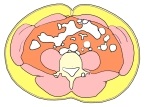
- Visceral fat : stored in the abdomen, around and between the abdominal organs.
Subcutaneous fat
Fat stored in the subcutaneous tissue, the deepest layer of the skin.
Women generally have more subcutaneous fat than men.
It is present all over the body but tends to be thicker in the lower abdomen, the buttocks and the upper arms. The breast also contains much fat.
Main roles
· Keeping the body temperature constant: it insulates the body against heat and cold.
· Cushioning: it softens mechanical impacts from outside.
· Storing energy: the fat stored in it is used as a source of energy.
· Secretion of physiologically active substances: adipose tissue releases hormones (for example leptin) and other active substances, and converts some male sex hormones into oestrogens.
Visceral fat
In contrast to subcutaneous fat under the skin, visceral fat lies in the abdomen, around and between the abdominal organs, for example in the mesentery and the greater omentum.
It tends to accumulate more in men; in women it tends to increase after the menopause, when the balance of hormones changes.
Main roles
· Storing energy: surplus nutrients are stored as neutral fat in fat cells. Visceral fat is broken down and released more readily than subcutaneous fat.
· Protecting the organs: it protects the abdominal organs from changes of temperature and from impacts, and helps to keep them in position.
· Secretion of physiologically active substances: as for subcutaneous fat.
Reference websites
[Wikipedia]
· Adipose tissue, Wikipedia.
Related terms
References and sources
- Further reading: Adipose tissue, Wikipedia.
- Federative International Programme for Anatomical Terminology (FIPAT). Terminologia Anatomica, 2nd ed. (TA2), 2019.