Alcohol
Also called the alcohols
Overview
In chemistry, an alcohol is the general name for compounds in which a hydrogen atom of a hydrocarbon (on a saturated carbon atom) is replaced by a hydroxyl group.
Hydrocarbon: a compound of carbon and hydrogen only; the simplest is methane.Hydroxyl group (hydroxy group): –OH
Alcohols are among the main metabolites in the body, and a wide variety of them is found in living things.
Example: a neutral fat is formed from glycerol (an alcohol) and fatty acids.
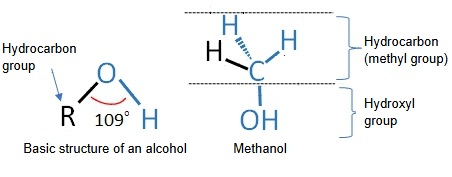
· The first substance to be recognized as an 'alcohol' was ethanol, the alcohol of alcoholic drinks.
· Compounds in which the hydroxyl group replaces a hydrogen atom of an aromatic ring are called phenols and are distinguished from alcohols.
· Many different alcohols occur in living organisms, for example glycerol, cholesterol and the sugar alcohols.
· Ethanol taken in with drinks is absorbed from the stomach and small intestine and broken down mainly in the liver, first to acetaldehyde and then to acetic acid.
Classification by structure
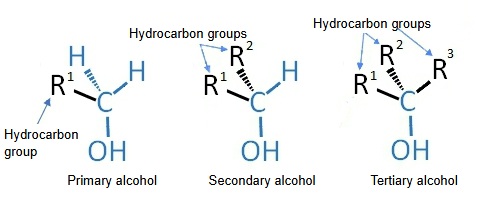
(1) Classification by the number of hydrocarbon groups bound to the carbon atom that carries the hydroxyl group
Primary to tertiary alcohols
| Name | Notes | |
|---|---|---|
| 1 | Primary alcohol | The hydroxyl group is bound to a primary carbon (a carbon bound to only one other carbon); the molecule contains –CH2OH. Examples: ethanol, 1-butanol |
| 2 | Secondary alcohol | The hydroxyl group is bound to a secondary carbon atom. Oxidation gives a ketone. Example: isopropyl alcohol (2-propanol), the simplest one |
| 3 | Tertiary alcohol | The hydroxyl group is bound to a tertiary carbon atom. Because the surrounding alkyl groups get in the way (steric hindrance), it reacts less readily than primary and secondary alcohols. Tertiary alcohols are hard to oxidize; strong oxidizing agents such as chromic acid break some of their C–C bonds. Example: tert-butyl alcohol, the simplest one |
(2) An alcohol with n hydroxyl groups in the molecule is called an n-hydric alcohol
Monohydric to trihydric alcohols
| Name | Notes | |
|---|---|---|
| 1 | Monohydric alcohol | One hydroxyl group in the molecule. Example: 2-propanol (isopropyl alcohol) |
| 2 | Dihydric alcohol | General name for aliphatic or alicyclic compounds with two hydroxyl groups bound to two different carbon atoms (diols, glycols). Example: propylene glycol (propane-1,2-diol) |
| 3 | Trihydric alcohol | Three hydroxyl groups in the molecule. Example: glycerol (glycerin) |
Related terms
References and sources
- Further reading: Alcohol (chemistry), Wikipedia.
- Further reading: Ethanol, Wikipedia.
- Federative International Programme for Anatomical Terminology (FIPAT). Terminologia Anatomica, 2nd ed. (TA2), 2019.