Groove (Latin: sulcus)
A groove, or sulcus, is a long, narrow furrow in the surface of a bone.
A tendon, nerve or blood vessel usually lies in it
A groove runs along the surface of a bone, whereas a notch is cut into its edge. The structure it holds is often named in the name of the groove.
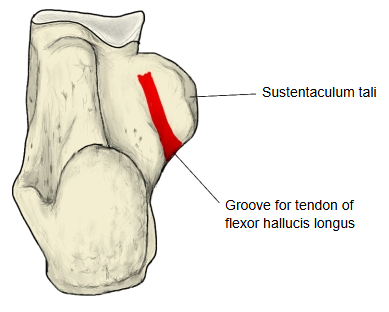
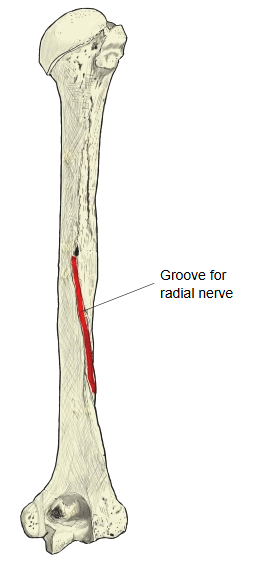
The intertubercular groove of the humerus lies between the greater and lesser tubercles and holds the tendon of the long head of the biceps brachii. The groove for the tendon of flexor hallucis longus lies under the sustentaculum tali of the calcaneus. The groove for the radial nerve winds around the back of the humerus, and the costal groove on the lower inner side of a rib shelters the intercostal vessels and nerve.
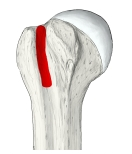 Intertubercular groove of humerus
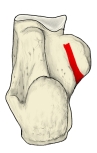 Groove for flexor hallucis longus on calcaneus
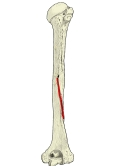 Groove for radial nerve on humerus
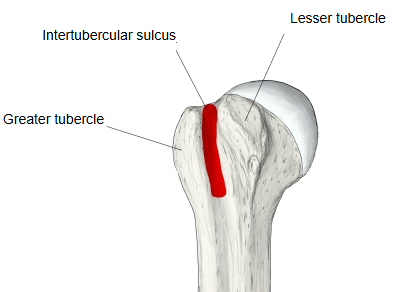
Related terms
- Notch
- Intertubercular groove
- Groove for tendon of flexor hallucis longus
- Groove for radial nerve
- Costal groove
References and sources
- Federative International Programme for Anatomical Terminology (FIPAT). Terminologia Anatomica, 2nd ed. (TA2), 2019.