Dorsal surface of scapula (Latin: facies posterior scapulae)
Also called the posterior surface
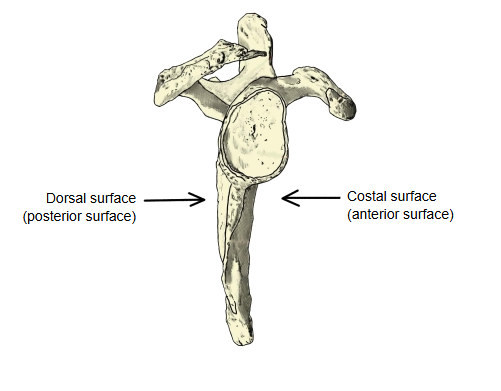
The dorsal surface is one of the two surfaces of the scapula, the one that faces backwards; it is also called the posterior surface.
The other is the costal surface, which faces the ribsScapula: the flat, triangular bone at the back of the shoulder
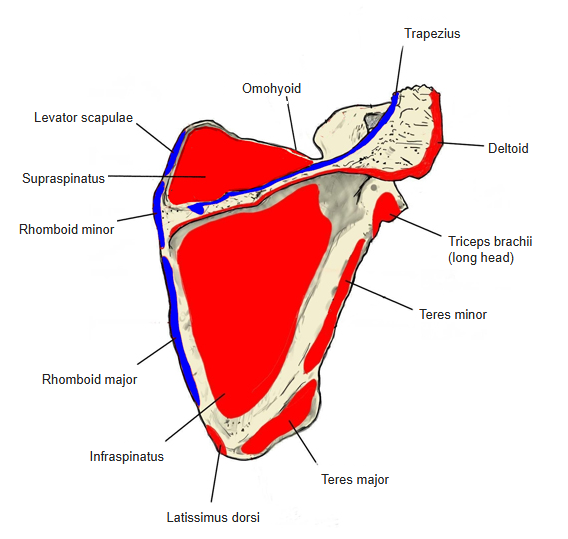
A ridge, the spine of the scapula, divides it into the upper supraspinous fossa and the lower infraspinous fossa.
Surfaces of
scapula
scapula
- Costal surface : faces the thorax and is concave as a whole. Also called the anterior surface.
- Dorsal surface : divided by a ridge (the spine of the scapula) into an upper and a lower fossa. Also called the posterior surface.
The surface is convex overall, and the spine runs across its upper part. The smaller supraspinous fossa gives origin to supraspinatus, the larger infraspinous fossa to infraspinatus. Near the lateral border, narrow areas give origin to teres minor and teres major, and the inferior angle may also give a few fibres to latissimus dorsi. The first figure shades the surface without the spine; some descriptions count the spine as part of the dorsal surface.
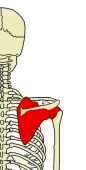 Upper back (posterior)
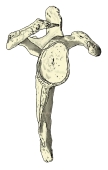 Right scapula (lateral)
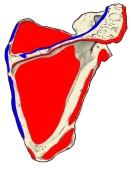 Muscle attachments (posterior)
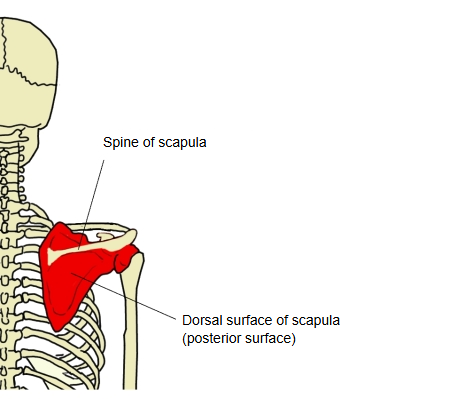
·
·
·
·
·
Where it is found
Related terms
- Costal surface of scapula
- Spine of scapula
- Supraspinous fossa
- Infraspinous fossa
- Medial border of scapula
- Lateral border of scapula
- Inferior angle of scapula
References and sources
- Further reading: Scapula, Wikipedia.
- Federative International Programme for Anatomical Terminology (FIPAT). Terminologia Anatomica, 2nd ed. (TA2), 2019.