Spine of scapula (Latin: spina scapulae)
Also called the scapular spine
Note
In the left drawing below, the spine of the scapula is shown in red together with the acromion (acromial part), because some anatomy textbooks treat the acromion as part of the spine. Most English illustrations that colour the spine, however, show it without the acromion (right drawing).
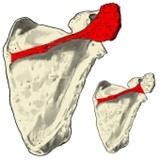 Right scapula (posterior)
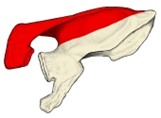 Right scapula (from above)
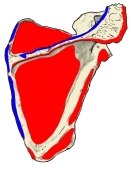 Muscle attachments (posterior)
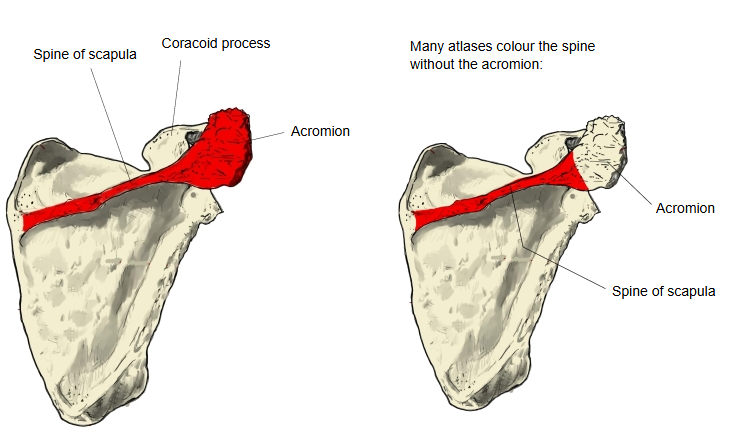
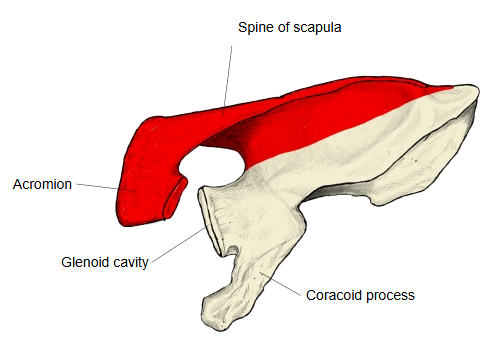
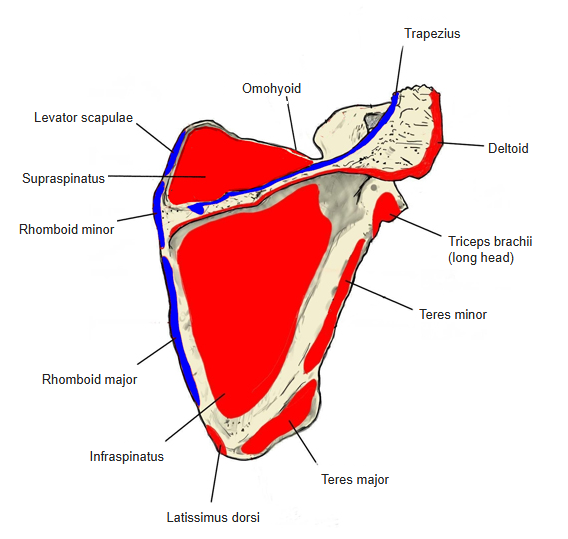
The spine ends laterally in a large, flattened process that projects beyond the glenoid cavity: the acromion. The trapezius is attached along the spine and the acromion, and the deltoid arises from them. Near the tip, on the medial edge of the acromion, is a small oval articular surface for the clavicle, whose outline is often indistinct.
It starts at the medial border as a smooth triangular area (the root of the spine), roughly level with the spinous process of the third thoracic vertebra (T3), over which the lower fibres of the trapezius glide.
Its free posterior edge, the crest of the spine, lies just under the skin: the trapezius inserts on its upper lip and the deltoid arises from its lower lip; a rough deltoid tubercle is often seen where the lower part of the trapezius inserts.
Its short, free lateral border forms the medial boundary of the spinoglenoid notch, which connects the two fossae.
The supraspinatus and infraspinatus arise in part from its upper and lower surfaces.
Reference websites
[Wikipedia]
· Spine of scapula, Wikipedia.
Where it is found
Related terms
- Acromion
- Acromial angle
- Deltoid tubercle
- Supraspinous fossa
- Infraspinous fossa
- Dorsal surface of scapula
- Medial border of scapula
References and sources
- Further reading: Spine of scapula, Wikipedia.
- Federative International Programme for Anatomical Terminology (FIPAT). Terminologia Anatomica, 2nd ed. (TA2), 2019.