Supraspinous fossa (Latin: fossa supraspinata)
· It is smaller and smoother than the infraspinous fossa.
· It is wider medially than laterally, like a boat.
· Supraspinatus arises from its medial two-thirds.
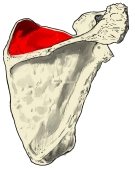 Right scapula (posterior)
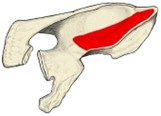 Right scapula (from above)
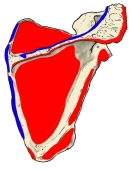 Muscle attachments (posterior)
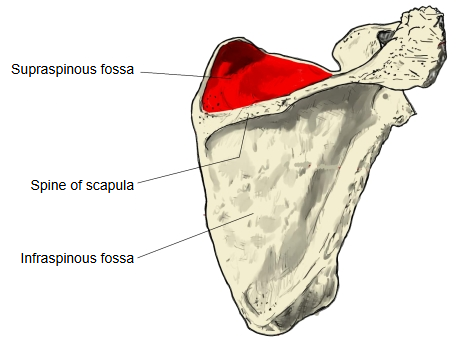
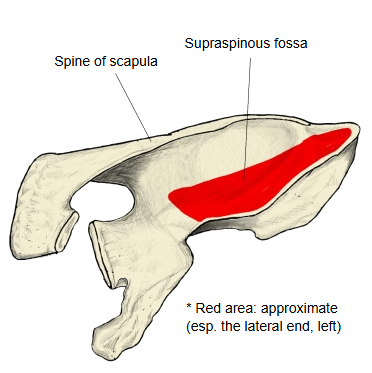
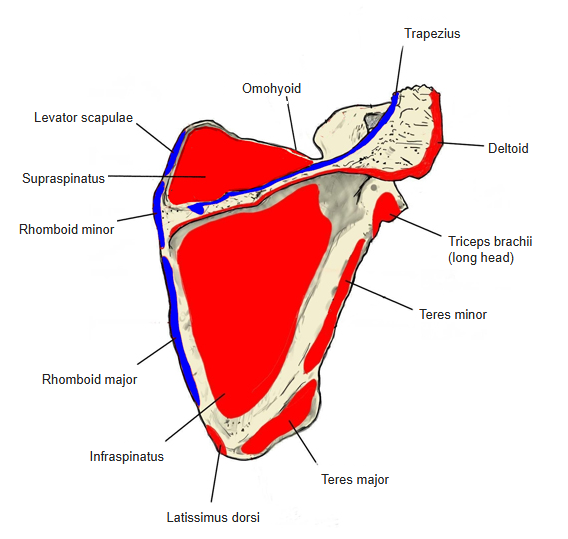
The supraspinous fossa is concave and smooth. It is bounded below by the spine, above by the superior border of the scapula and laterally by the base of the acromion. It is covered by trapezius. Supraspinatus arises from roughly its medial two-thirds; its tendon passes under the acromion to the greater tubercle of the humerus. The suprascapular nerve enters the fossa through the suprascapular notch, with the suprascapular artery passing above the superior transverse scapular ligament; both supply supraspinatus. Laterally the fossa communicates with the infraspinous fossa through the spinoglenoid notch, at the lateral end of the spine.
Reference websites
[Wikipedia]
· Supraspinous fossa, Wikipedia.
· Supraspinatus muscle, Wikipedia.
[Websites with illustrations]
· Supraspinous fossa of the left scapula (1) (Wikimedia Commons)

· Supraspinous fossa of the left scapula (2) (Wikimedia Commons)

· The scapula (TeachMeAnatomy)
Where it is found
Related terms
- Infraspinous fossa
- Spine of scapula
- Dorsal surface of scapula
- Superior border of scapula
- Suprascapular notch
- Acromion
References and sources
- Further reading: Supraspinous fossa, Wikipedia.
- Federative International Programme for Anatomical Terminology (FIPAT). Terminologia Anatomica, 2nd ed. (TA2), 2019.