Acromion (Latin: acromion)
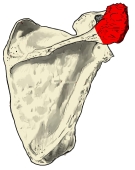 Right scapula (posterior)
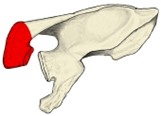 Right scapula (from above)
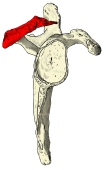 Right scapula (lateral)
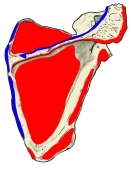 Muscle attachments (posterior)
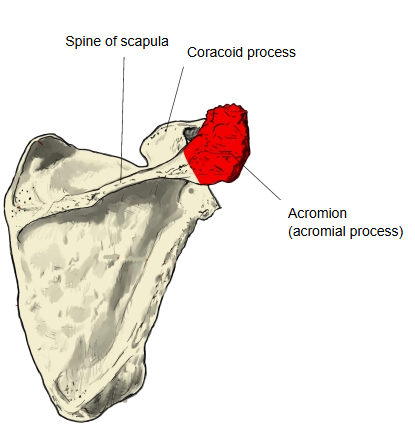
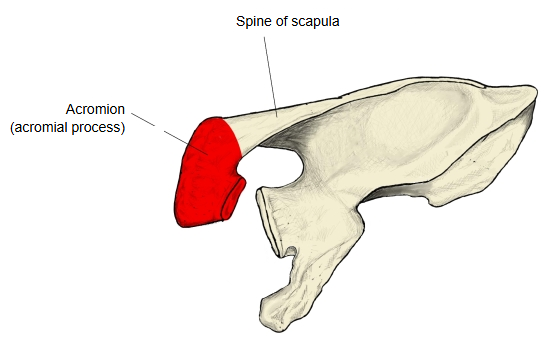
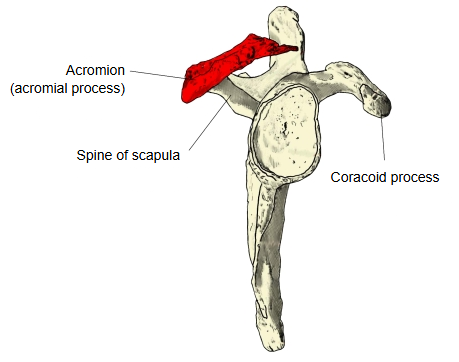
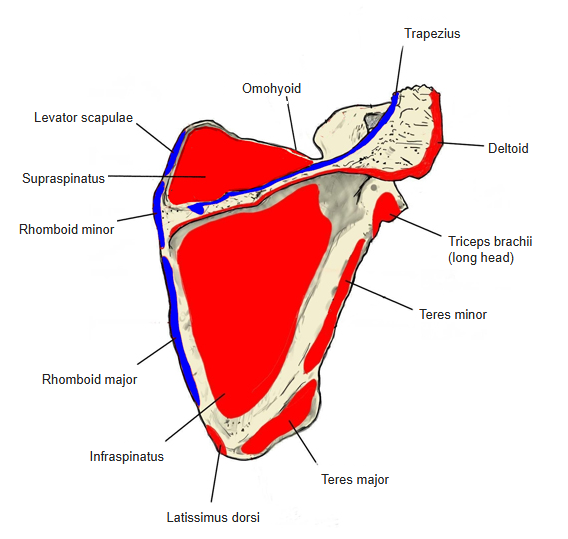
The spine of the scapula ends laterally in this large, flat process, which projects beyond the glenoid cavity and forms the highest point of the shoulder. It overhangs the shoulder joint and, with the coracoacromial ligament, forms a roof above it (the coracoacromial arch). The trapezius inserts and the deltoid arises along the spine and the acromion. Near its tip, the medial margin carries a small oval facet for the clavicle (its outline is not very distinct), forming the acromioclavicular joint. The acromial angle, where its lateral border turns into the crest of the spine, is easy to feel through the skin. At the lateral end of the root of the spine (where it arises from the dorsal surface of the scapula), the supraspinous and infraspinous fossae communicate with each other next to the glenoid cavity.
An ossification centre of the acromion that fails to fuse with the rest (os acromiale) is found in a small proportion of people and can be mistaken for a fracture.
Reference websites
[Wikipedia]
· Acromion, Wikipedia.
[Websites with illustrations]
· Acromion of the left scapula (illustration) (Wikimedia Commons)

Where it is found
Related terms
- Spine of scapula
- Acromial angle
- Clavicular facet of acromion
- Acromioclavicular joint
- Coracoid process
- Acromial end of clavicle
References and sources
- Further reading: Acromion, Wikipedia.
- Federative International Programme for Anatomical Terminology (FIPAT). Terminologia Anatomica, 2nd ed. (TA2), 2019.