Groove for ulnar nerve (Latin: sulcus nervi ulnaris)
Also called the ulnar groove or the sulcus for ulnar nerve
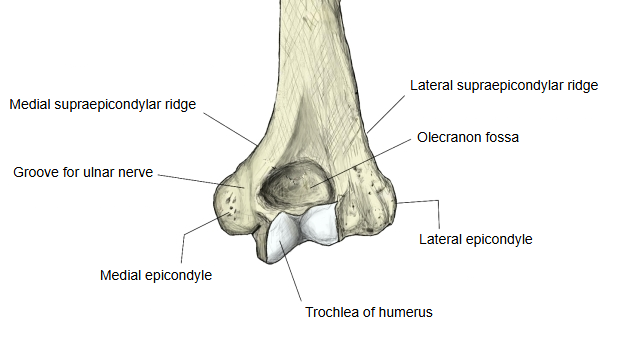
The groove for ulnar nerve is a shallow vertical groove on the posterior surface of the medial epicondyle. It runs down behind the epicondyle and continues below into the deep notch that curves forwards round the medial side of the trochlea of humerus.
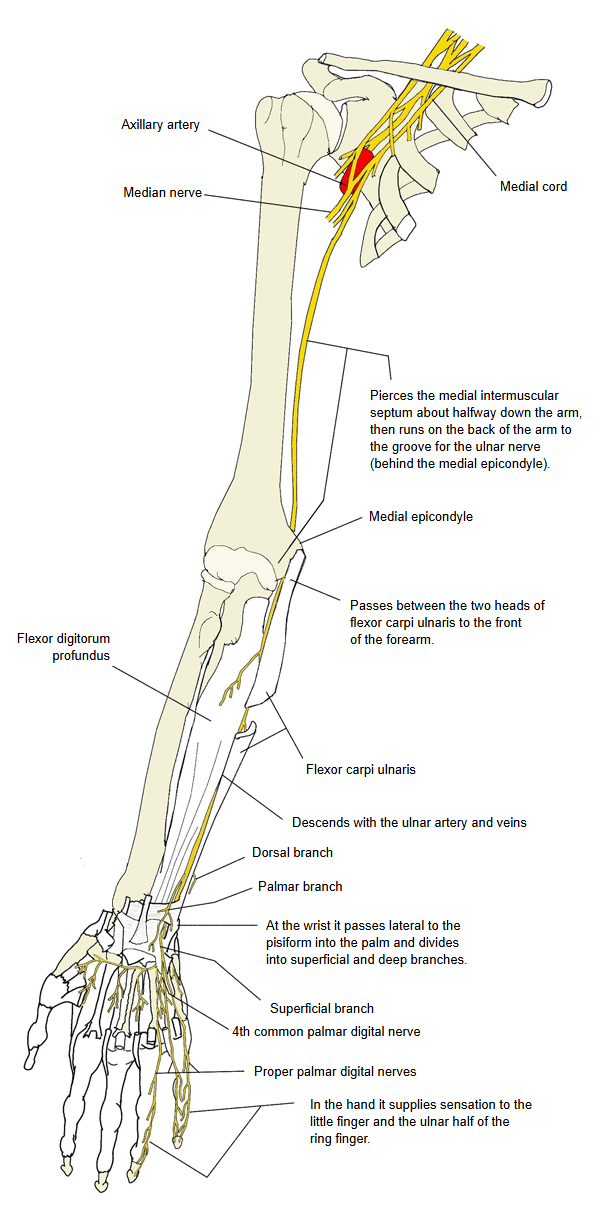
It lodges the ulnar nerve, which lies directly against the bone here, covered only by skin and fascia, so it is easily knocked (the "funny bone"). Below the groove the nerve passes between the two heads of flexor carpi ulnaris into the front of the forearm (the cubital tunnel). Compression or friction of the nerve here causes cubital tunnel syndrome, with tingling of the little finger and the ulnar side of the ring finger.
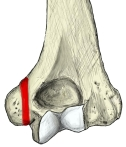 Right humerus (posterior)
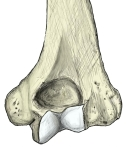 Right humerus (posterior)
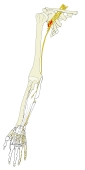 Course of the ulnar nerve
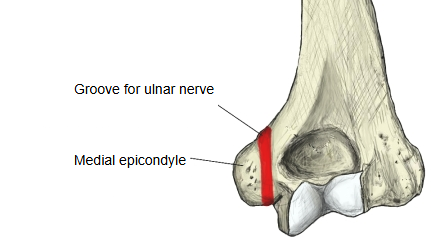
Reference websites
[Wikipedia]
· Ulnar nerve, Wikipedia.
· Cubital tunnel, Wikipedia.
[Websites with illustrations]
· The humerus (TeachMeAnatomy)
Where it is found
Related terms
- Medial epicondyle
- Trochlea of humerus
- Olecranon fossa
- Medial supracondylar ridge
- Lower end of humerus
- Groove for radial nerve
References and sources
- Further reading: Ulnar nerve, Wikipedia.
- Further reading: Cubital tunnel, Wikipedia.
- Federative International Programme for Anatomical Terminology (FIPAT). Terminologia Anatomica, 2nd ed. (TA2), 2019.