Body of ulna (Latin: corpus ulnae)
Also called the shaft of ulna
The body of the ulna is one of the three parts of the ulna: the long middle part between the upper and lower ends, which forms the shaft of the bone.
Three parts: the upper end, the body and the lower endShaft: thick and three-sided above, it narrows steadily downwards and is almost round near the wrist; it is gently curved along its length
It has three borders and three surfaces:
Borders
- Anterior border : rounded; clear in its upper part, it runs down from the medial side of the tuberosity towards the styloid process.
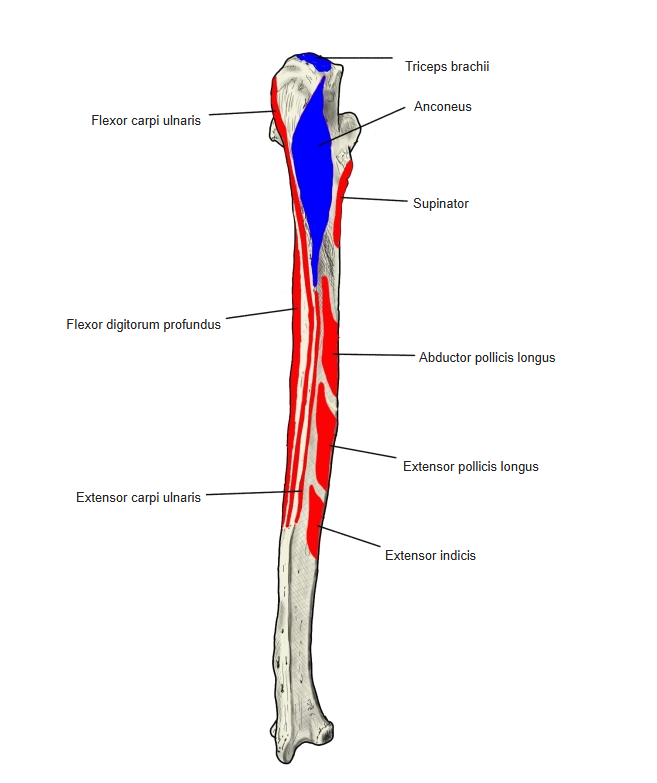
- Posterior border : rounded and subcutaneous; clear in its upper three quarters, it can be felt along the back of the forearm from the olecranon. Flexor carpi ulnaris and extensor carpi ulnaris arise from it by a shared aponeurosis.
- Interosseous border : (lateral border) the sharpest border, facing the radius; the interosseous membrane of the forearm is attached to it.
Surfaces
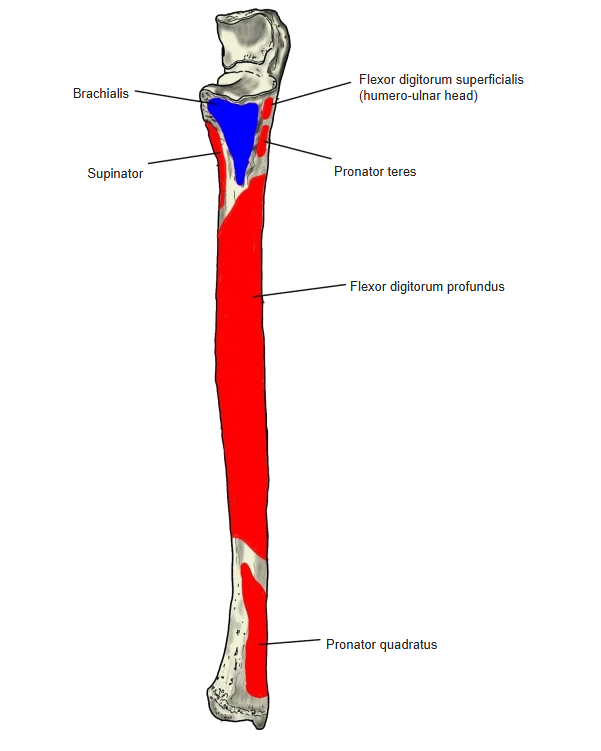
- Anterior surface : between the anterior and interosseous borders; flexor digitorum profundus above, pronator quadratus below.
- Posterior surface : between the interosseous and posterior borders; anconeus above, then abductor pollicis longus, extensor pollicis longus and extensor indicis.
- Medial surface : between the anterior and posterior borders; covered above by flexor digitorum profundus, subcutaneous below.
Some anatomy texts also list the supinator crest, the interosseous border and the tuberosity of the ulna as features of the body. Sources differ on the tuberosity: some count it as part of the upper end, others as part of the body.
Main muscles that arise from the body (muscles attached to it only in a small part are left out):
| Anterior surface | Flexor digitorum profundus; pronator quadratus (lower quarter) |
| Posterior border | Flexor carpi ulnaris, extensor carpi ulnaris (by a shared aponeurosis) |
| Posterior surface | Abductor pollicis longus, extensor pollicis longus, extensor indicis |
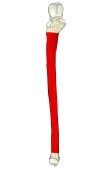 Parts of the right ulna (anterior)
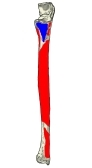 Muscle attachments (anterior)
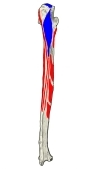 Muscle attachments (posterior)
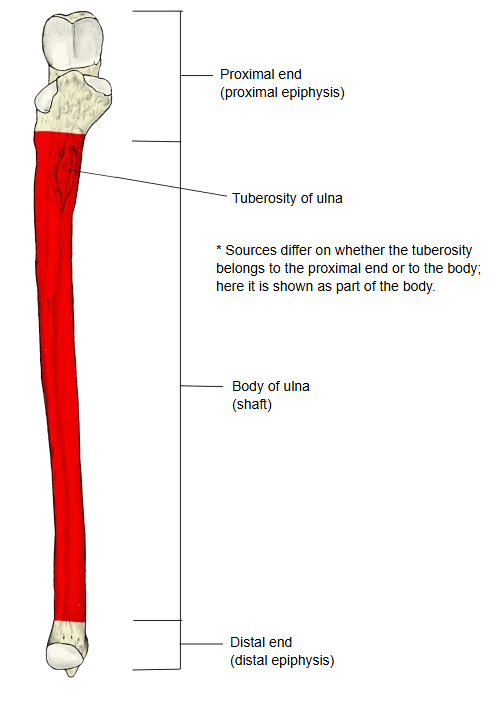
Ulna
- Proximal epiphysis : larger than the distal end. = Upper end
- Body (shaft) of ulna : the middle part that forms the shaft; gently curved, with three borders and three surfaces
- Distal epiphysis : smaller than the proximal end. = Lower end
Reference websites
[Wikipedia]
· Ulna, Wikipedia.
· Interosseous membrane of forearm, Wikipedia.
[Websites with illustrations]
· Bones of the left forearm, anterior aspect (Gray's Anatomy, fig. 213) (Wikimedia Commons)

· Bones of the left forearm, posterior surface (Gray's Anatomy, fig. 214) (Wikimedia Commons)

· The ulna (TeachMeAnatomy)
Where it is found
Related terms
- Anterior border of ulna
- Posterior border of ulna
- Interosseous border of ulna
- Anterior surface of ulna
- Posterior surface of ulna
- Medial surface of ulna
- Tuberosity of ulna
References and sources
- Further reading: Ulna, Wikipedia.
- Federative International Programme for Anatomical Terminology (FIPAT). Terminologia Anatomica, 2nd ed. (TA2), 2019.