Interosseous membrane of forearm (Latin: membrana interossea antebrachii)
Also called the antebrachial interosseous membrane
A fibrous membrane that joins the interosseous border of the radius to the interosseous border of the ulna, below the level of the radial tuberosity. It is a fibrous joint (syndesmosis) between the shafts of the radius and ulna, lying between the proximal and distal radioulnar joints. It separates the flexor muscles at the front from the extensor muscles at the back, and several deep muscles of both groups arise from it.
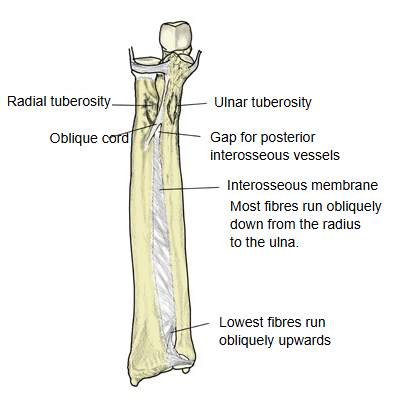
More details: most of its fibres run obliquely downwards from the radius to the ulna, but in the lower part some fibres run the other way, obliquely upwards. Force from the hand, received mainly by the radius, is passed through the fibres to the ulna. Above the membrane is the oblique cord, a small band running from just beside the tuberosity of the ulna to just below the radial tuberosity. Through the gap between the oblique cord and the upper border of the membrane the posterior interosseous artery passes to the back of the forearm. Near the lower end of the membrane the anterior interosseous artery pierces it to reach the back. The corresponding membrane in the leg is the interosseous membrane of the leg.
Reference websites
[Wikipedia]
· Interosseous membrane of forearm, Wikipedia.
[Websites with illustrations]
· Bones of the left forearm, anterior aspect (Gray's Anatomy, fig. 213) (Wikimedia Commons)

· The radius: proximal, shaft and distal (TeachMeAnatomy)
Related terms
- Forearm flexor muscles
- Forearm extensor muscles
- Interosseous border of radius
- Interosseous border of ulna
- Proximal radioulnar joint
- Distal radioulnar joint
- Radial tuberosity
- Tuberosity of ulna
- Interosseous membrane of leg
References and sources
- Further reading: Interosseous membrane of forearm, Wikipedia.
- Federative International Programme for Anatomical Terminology (FIPAT). Terminologia Anatomica, 2nd ed. (TA2), 2019.