Xiphoid process (Latin: processus xiphoideus)
Also called the xiphisternum or the ensiform process
· It forms from a cartilaginous process that was originally paired; where the two halves have not fully joined, a foramen remains.
· It ossifies late (see below).
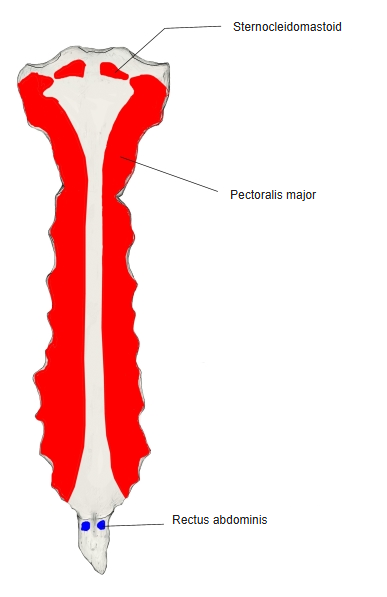
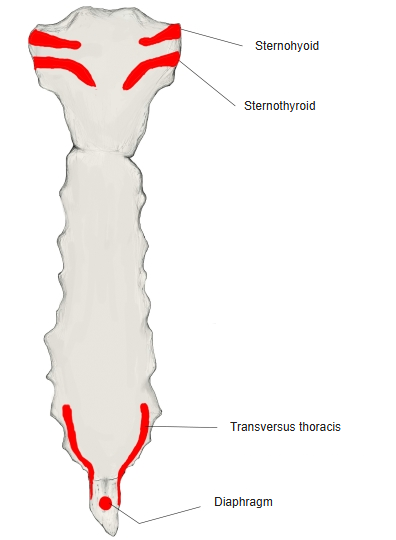
Muscle attachments: rectus abdominis (insertion, in front), the sternal part of the diaphragm (behind) and transversus thoracis (only a few fibres; most arise from the body of the sternum).
Other attachments: the linea alba and the aponeuroses of the abdominal muscles.
- Manubrium : the upper part, about a quarter of the length; it articulates with the clavicle at the sternoclavicular joint.
- Body : the middle part between the manubrium and the xiphoid process, nearly 60% of the length.
- Xiphoid process : the cartilaginous process at the lower end; it ossifies late in life.
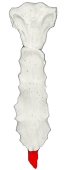 Sternum (anterior)
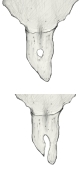 Variations of the xiphoid process
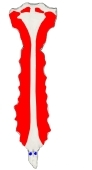 Muscle attachments (anterior)
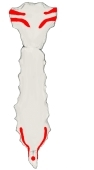 Muscle attachments (posterior)
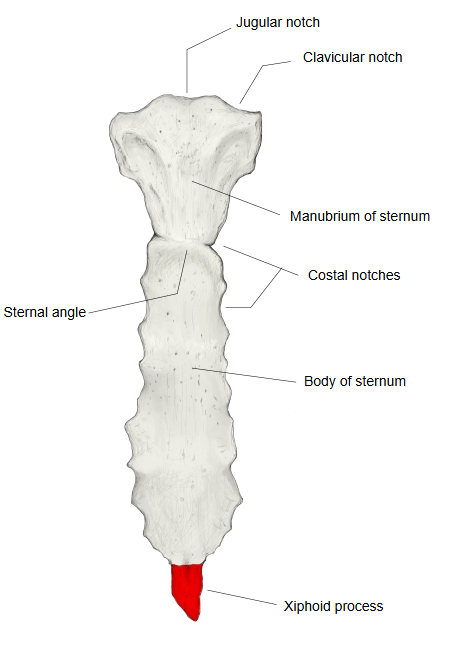
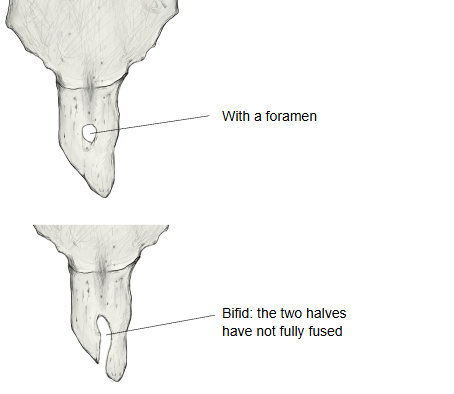
It is a cartilaginous process below the body of the sternum, formed when two originally paired halves join. Its shape therefore varies a great deal: it may be pointed, broad, curved, bifid or perforated by a foramen. Late in life it ossifies and becomes joined to the body of the sternum by bone.
Even in adults it is largely made of cartilage, and it often becomes fully bony only in middle or old age, so in prepared dry skeletons a complete xiphoid process is usually seen only in older individuals.
It joins the body of the sternum at the xiphisternal joint, at about the level of the ninth thoracic vertebra; the 7th costal cartilage meets the sternum at this joint, and the costoxiphoid ligaments join the xiphoid process to the 7th costal cartilages. It lies in the upper angle between the right and left costal arches (the infrasternal angle). The bifid and perforated forms are harmless variations.
Reference websites
[Wikipedia]
· Xiphoid process, Wikipedia.
· Sternum, Wikipedia.
[Websites with illustrations]
· The sternum (TeachMeAnatomy)
· Sternum (Kenhub)
Where it is found
Related terms
References and sources
- Further reading: Xiphoid process, Wikipedia.
- Further reading: Sternum, Wikipedia.
- Federative International Programme for Anatomical Terminology (FIPAT). Terminologia Anatomica, 2nd ed. (TA2), 2019.