Posterior border of fibula (Latin: margo posterior fibulae)
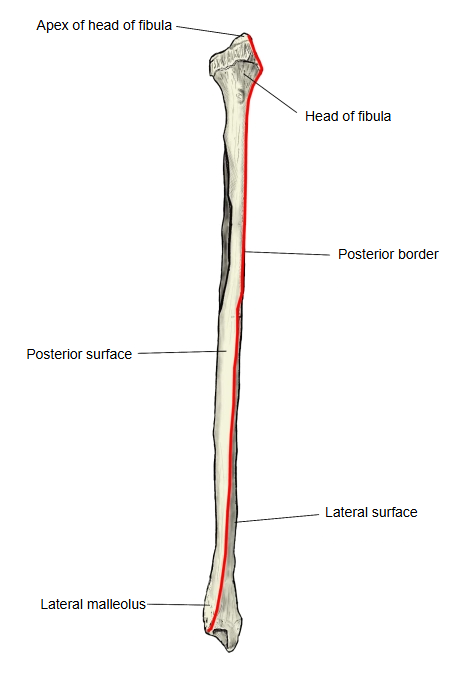
One of the three borders of the shaft of the fibula.
The posterior border begins at the apex of the head of the fibula and ends at the back edge of the lateral malleolus. It is rounded in its upper part and becomes somewhat ridge-like below. It separates the lateral surface of the shaft from the posterior surface. (The medial surface lies between the anterior border and the interosseous border; it is very narrow in its upper third and broader, slightly hollowed into a shallow groove, in its lower third.)
fibula
- Anterior border : the sharpest of the three; its lower end divides in two.
- Posterior border : blunt, and rounded especially in its upper part.
- Interosseous border : a fairly sharp ridge, but often indistinct in its upper part.
In the Wikipedia article on the fibula, which follows Gray's Anatomy, the same border is called the postero-lateral border.
It is prominent. Because the shaft is twisted, it faces outwards above, backwards in the middle and backwards and slightly inwards below. It gives attachment to the posterior intermuscular septum of the leg, which separates fibularis longus and fibularis brevis on the lateral surface from the flexor muscles on the posterior surface.
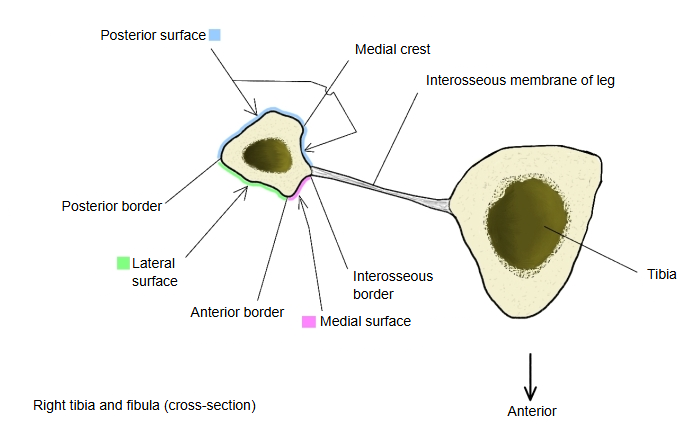
Where it is found
Related terms
- Shaft of fibula
- Anterior border of fibula
- Interosseous border of fibula
- Lateral surface of fibula
- Posterior surface of fibula
- Apex of head of fibula
- Lateral malleolus
References and sources
- Further reading: Fibula, Wikipedia.
- Federative International Programme for Anatomical Terminology (FIPAT). Terminologia Anatomica, 2nd ed. (TA2), 2019.