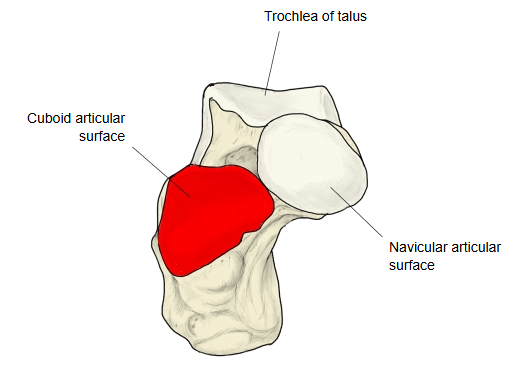
Cuboid articular surface (Latin: facies articularis cuboidea)
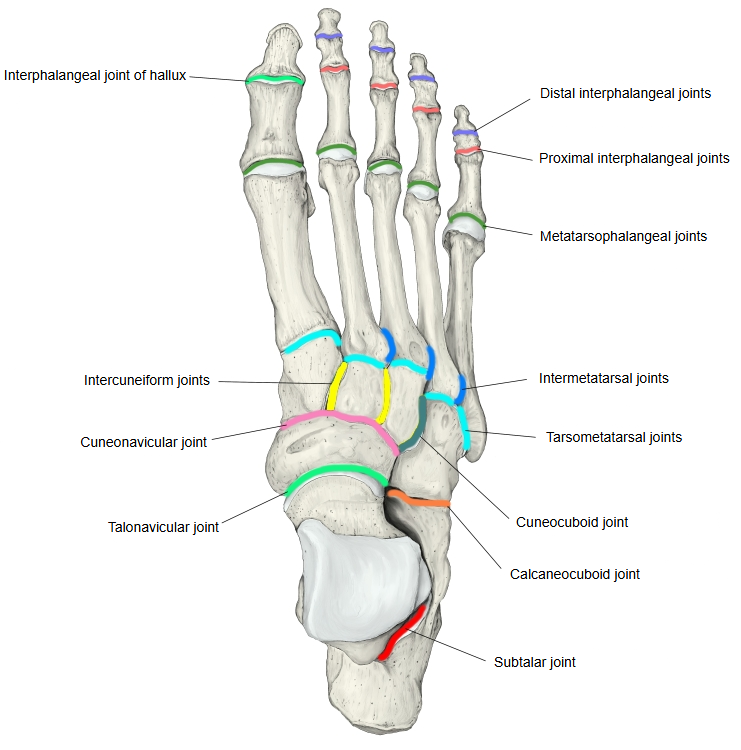
The joint surface on the front end of the calcaneus that meets the cuboid. It is roughly triangular and saddle-shaped: concave from above downwards and convex from side to side. With the cuboid it forms the calcaneocuboid joint. The saddle shape locks the two bones together, which helps keep the lateral side of the foot rigid when pushing off. The joint is supported by the bifurcate ligament, the dorsal calcaneocuboid ligament and, below, the plantar calcaneocuboid and long plantar ligaments.
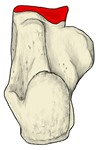 Right calcaneus (inferior)
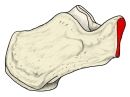 Right calcaneus (lateral)
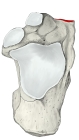 Right calcaneus (superior)
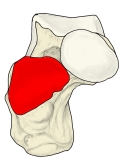 Right talus and calcaneus (anterior)
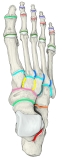 Right foot (dorsal)
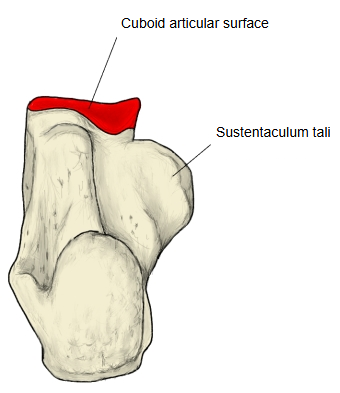
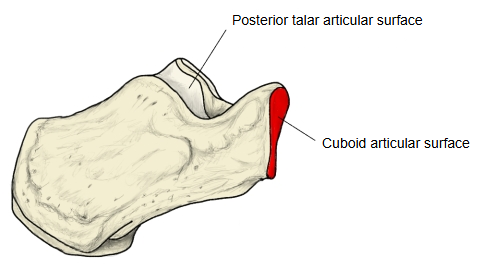
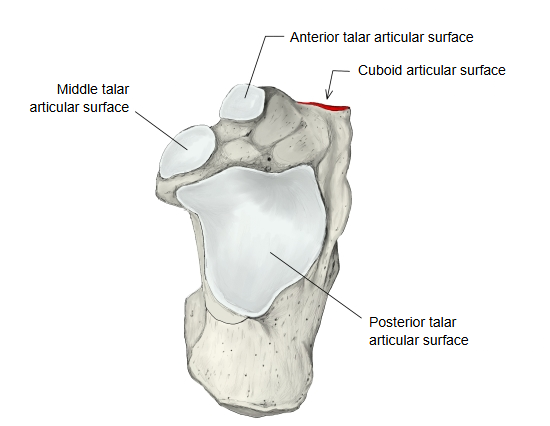
Where it is found
Related terms
- Calcaneocuboid joint
- Calcaneal tubercle
- Posterior talar articular surface
- Anterior talar articular surface
- Calcaneal process of cuboid
- Cuboid
- Calcaneus
References and sources
- Further reading: Calcaneus, Wikipedia.
- Further reading: Calcaneocuboid joint, Wikipedia.
- Federative International Programme for Anatomical Terminology (FIPAT). Terminologia Anatomica, 2nd ed. (TA2), 2019.