Calcaneal tubercle (Latin: tuberculum calcanei)
Also called Anterior tubercle of calcaneus
On the plantar (under) surface of the calcaneus, near its front end, a groove runs along the lower edge of the cuboid articular surface; just behind this groove the bone rises into a low, rounded elevation, the calcaneal tubercle. The plantar calcaneocuboid ligament (short plantar ligament) arises from the tubercle and the groove in front of it and runs forward to the cuboid. Behind the tubercle, the plantar surface gives origin to part of quadratus plantae; further back, the underside of the calcaneal tuberosity gives origin to abductor hallucis and flexor digitorum brevis. The tendon of fibularis longus, which passes nearby on its way under the cuboid, sometimes contains a sesamoid bone.
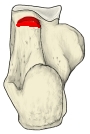 Right calcaneus (inferior)
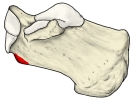 Right calcaneus (medial)
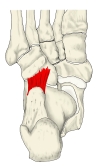 Right foot (plantar)
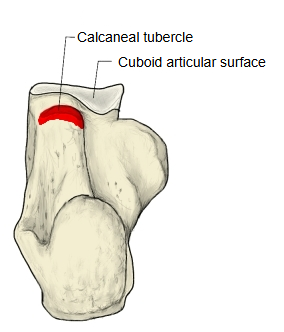
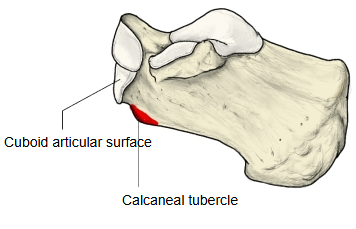
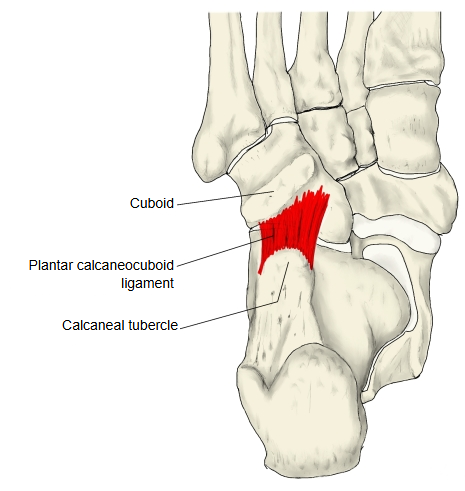
· It lies at the front of the plantar surface, well in front of the calcaneal tuberosity at the back of the heel (with its medial and lateral processes); the two should not be confused. The long plantar ligament arises from the plantar surface behind the tubercle and passes forward over it.
· Sources differ in naming: some older texts also call the medial and lateral processes of the calcaneal tuberosity "tubercles". In front of the tubercle, the cuboid articular surface forms the calcaneocuboid joint.
Reference websites
[Wikipedia]
· Calcaneus, Wikipedia.
· Plantar calcaneocuboid ligament, Wikipedia.
[Websites with illustrations]
· Bones of the right foot, plantar surface (Gray's Anatomy, fig. 269) (Wikimedia Commons)

· Calcaneus (Kenhub)
Where it is found
Related terms
- Calcaneal tuberosity
- Cuboid articular surface
- Body of calcaneus
- Medial process of calcaneal tuberosity
- Lateral process of calcaneal tuberosity
- Calcaneocuboid joint
- Calcaneus
References and sources
- Further reading: Calcaneus, Wikipedia.
- Further reading: Plantar calcaneocuboid ligament, Wikipedia.
- Federative International Programme for Anatomical Terminology (FIPAT). Terminologia Anatomica, 2nd ed. (TA2), 2019.