Latin: phalanges distales manus
Overview
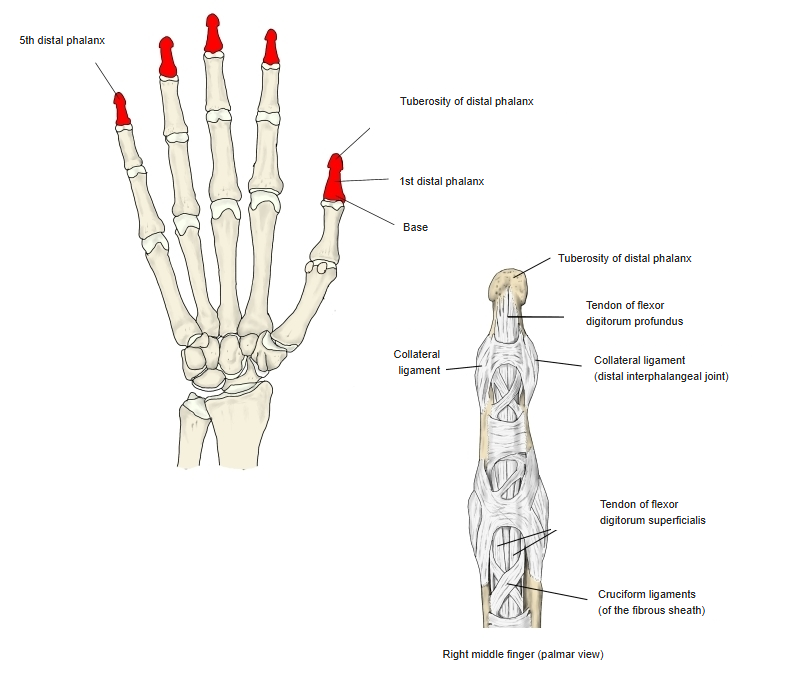
- The most distal of the bones of the digits; there is one in each digit, five in all, from the 1st (thumb) to the 5th (little finger).
- The proximal end (base) has an articular surface matching the head of the middle phalanx (in the thumb, the proximal phalanx).
- The distal end is a flattened oval plate with a rough tuberosity of the distal phalanx, which supports the fingertip and nail.
- Bones of the upper limb (one side)
- Shoulder girdle
- Clavicle
- Scapula
- Free upper limb
- Arm
- Humerus
- Forearm
- Radius ← thumb side
- Ulna ← little-finger side
- Hand
- Carpal bones (8)
- Metacarpal bones (5)
- Phalanges (14)
- Arm
- Shoulder girdle
Illustrations
Distal phalanges of the right hand, with the middle finger (palmar)
Articulations
| # | Bone | Joint |
|---|---|---|
| 1 | Middle phalanges (thumb: proximal phalanx) | Distal interphalangeal joints (thumb: interphalangeal joint) |
Muscle attachments
- Numbered figures of the muscle attachments on the whole hand: see Metacarpal bones → Muscle attachments.
- Origin of: none
- Insertion of: Flexor digitorum profundus, Flexor pollicis longus
Flexor digitorum profundus inserts on the palmar side of the base of the distal phalanges of the 2nd–5th fingers; flexor pollicis longus on that of the thumb.
References and sources
- Further reading: Phalanx bone, Wikipedia.