Latin: ossa metacarpi · the metacarpals
Overview
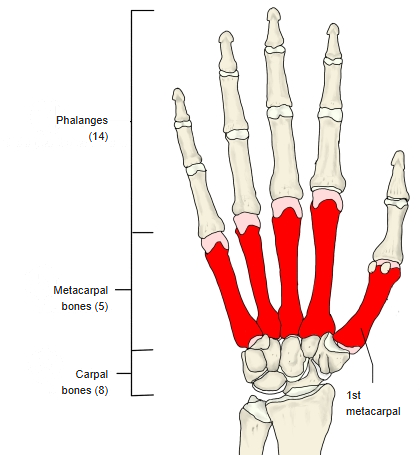
- The five long bones of the hand, lying between the carpal bones and the phalanges (finger bones).
- They are numbered from the thumb side: the 1st metacarpal is that of the thumb and the 5th metacarpal that of the little finger.
- Their bases articulate with the distal row of carpal bones; between the bodies lie the interosseous spaces, occupied by the palmar and dorsal interossei.
- Bones of the upper limb (one side)
- Shoulder girdle
- Clavicle
- Scapula
- Free upper limb
- Arm
- Humerus
- Forearm
- Radius ← thumb side
- Ulna ← little-finger side
- Hand
- Carpal bones (8)
- Metacarpal bones (5)
- Phalanges (14)
- Arm
- Shoulder girdle
Illustrations
Bones of the hand
Articulations
| # | Bone | Joint |
|---|---|---|
| 1 | Distal carpal bones (trapezium, trapezoid, capitate, hamate) | Carpometacarpal joints |
| 2 | Neighbouring metacarpals (bases of the 2nd–5th; the 1st does not articulate with the 2nd) | Intermetacarpal joints |
| 3 | Proximal phalanges | Metacarpophalangeal joints |
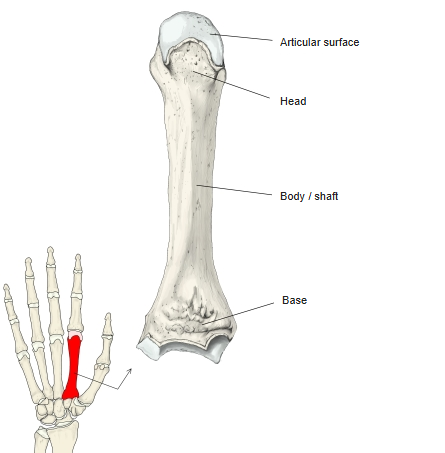
Parts of a metacarpal
- Head – the thickened distal end.
- Body (shaft) – the tubular middle part.
- Base – the thickened proximal end.
Parts of a metacarpal
The five metacarpals
- 1st metacarpal – the shortest, with the thickest body.
- 2nd metacarpal – the longest, with the largest base.
- 3rd metacarpal – has a styloid process projecting from the radial side of the dorsal surface of its base.
- 4th metacarpal – shorter and smaller than the 3rd.
- 5th metacarpal – the second shortest.
Muscle attachments
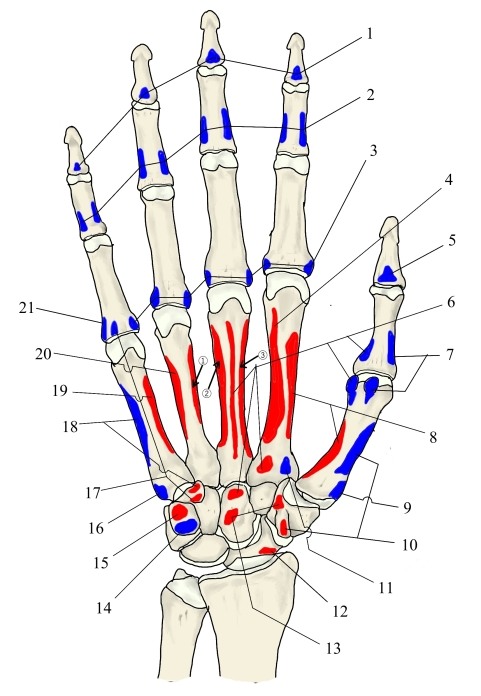
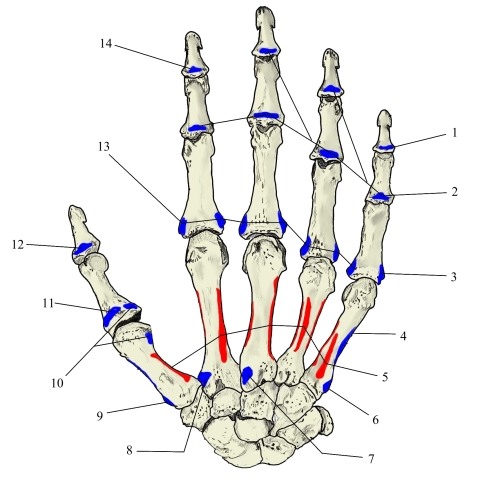
Red: origin · blue: insertion. The figures show the whole hand (carpals, metacarpals and phalanges).
Hand (palmar view)
Hand (dorsal view)
References and sources
- Further reading: Metacarpal bones, Wikipedia.