Latin: phalanges mediae manus
Overview
- The finger bones between the proximal and distal phalanges.
- There is one in each finger except the thumb, which has only two phalanges – so there are four, in the 2nd to 5th digits; the thumb (1st digit) has no middle phalanx.
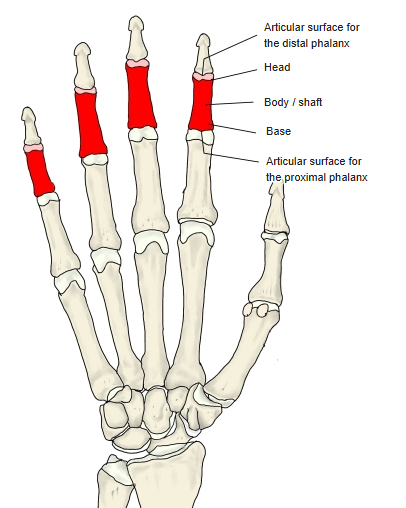
- They are similar in shape to the proximal phalanges but shorter; each has a head, a body (shaft) and a base.
- Bones of the upper limb (one side)
- Shoulder girdle
- Clavicle
- Scapula
- Free upper limb
- Arm
- Humerus
- Forearm
- Radius ← thumb side
- Ulna ← little-finger side
- Hand
- Carpal bones (8)
- Metacarpal bones (5)
- Phalanges (14)
- Arm
- Shoulder girdle
Illustrations
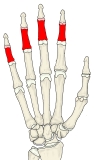
Middle phalanges of the left hand (palmar)
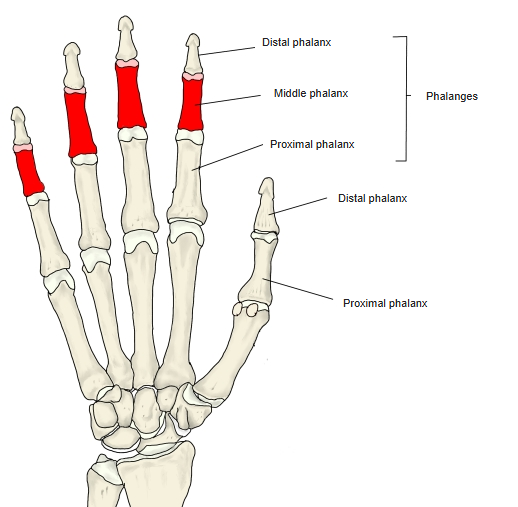
Articulations
| # | Bone | Joint |
|---|---|---|
| 1 | Proximal phalanges | Proximal interphalangeal joints |
| 2 | Distal phalanges | Distal interphalangeal joints |
Parts and joints
- Head – the thickened distal end.
- Body (shaft) – the tubular middle part.
- Base – the thickened proximal end.
- The distal end has an articular surface for the distal phalanx.
- The proximal end has an articular surface for the proximal phalanx.
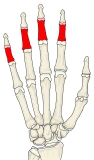
Parts of a middle phalanx
Muscle attachments
- Numbered figures of the muscle attachments on the whole hand: see Metacarpal bones → Muscle attachments.
References and sources
- Further reading: Phalanx bone, Wikipedia.