Latin: Aorta
Overview
- The largest artery of the body. It carries oxygen-rich blood from the left ventricle to the whole body (systemic circulation).
- Divided into the ascending aorta, the aortic arch and the descending aorta; the descending aorta is the thoracic aorta above the diaphragm and the abdominal aorta below it.
- Ends at about the level of the 4th lumbar vertebra by dividing into the right and left common iliac arteries.
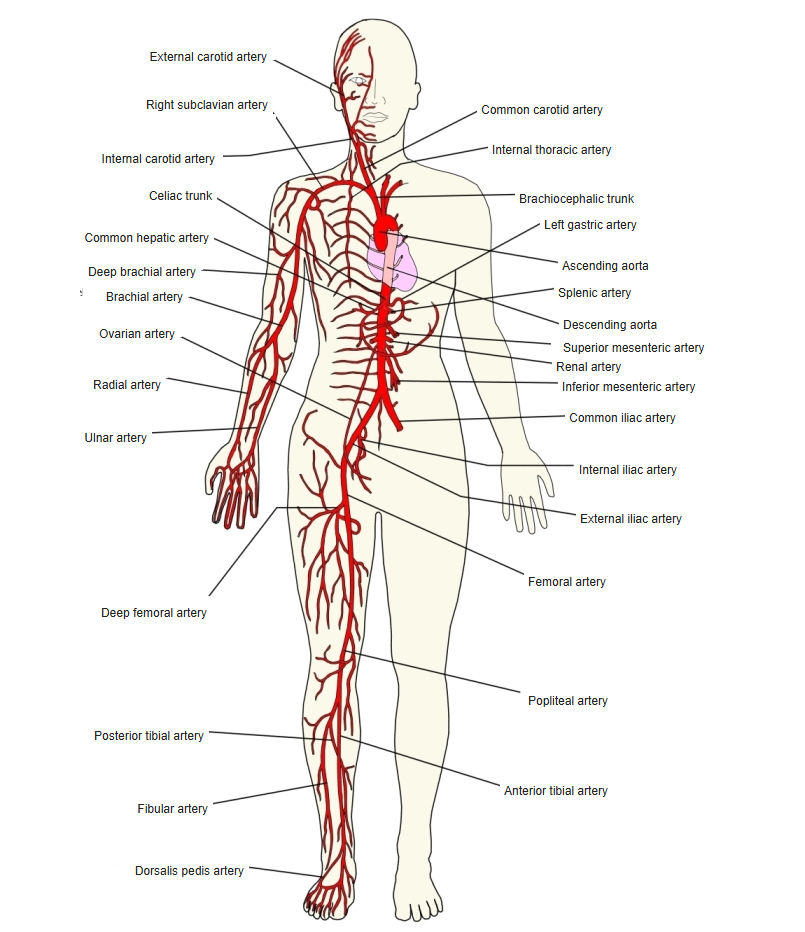
Main arteries of the body 
Parts of the aorta
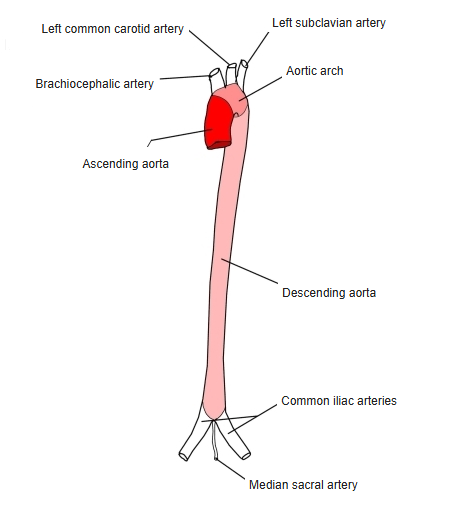
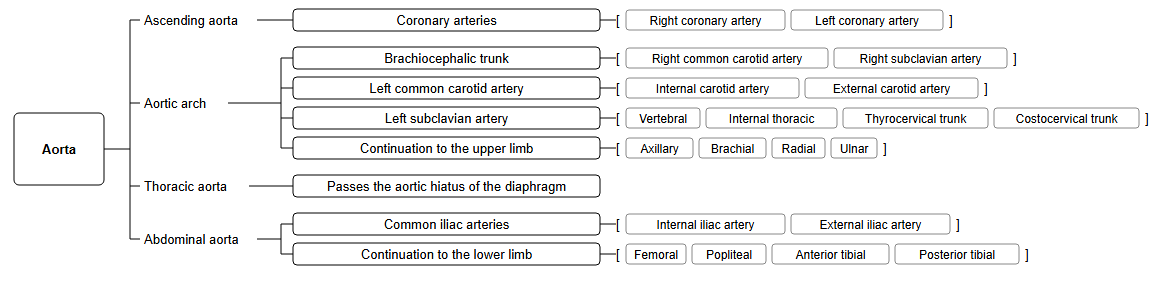
Parts
| Part | Course | Main branches |
|---|---|---|
| Ascending aorta | From the aortic valve upward, behind the sternum | Right and left coronary arteries |
| Aortic arch | Arches backward and to the left over the root of the left lung | Brachiocephalic trunk, left common carotid artery, left subclavian artery |
| Thoracic aorta | Descends in the posterior mediastinum, left of the vertebral bodies | Posterior intercostal, bronchial and esophageal arteries |
| Abdominal aorta | From the aortic hiatus of the diaphragm (T12) to L4 | Celiac trunk, mesenteric, renal, gonadal and lumbar arteries; common iliac arteries |
Clinical notes
- An aortic aneurysm is an abnormal widening, most often of the abdominal aorta.
- In aortic dissection blood enters the wall of the aorta through a tear in its inner layer.
References and sources
- Further reading: Aorta, Wikipedia.