Apophysis (Latin: apophysis)
In its widest sense the word covers any process or outgrowth of a bone. Many authors narrow it to a projection that grows from its own ossification centre and later fuses with the rest of the bone; others use it for a projection with no ossification centre of its own. When you meet the word, check which sense is meant.
An apophysis is different from an epiphysis. An epiphysis is an end of a long bone, usually bears a joint surface, and its growth plate adds to the length of the bone. An apophysis is typically a site where a tendon or ligament pulls on the bone.
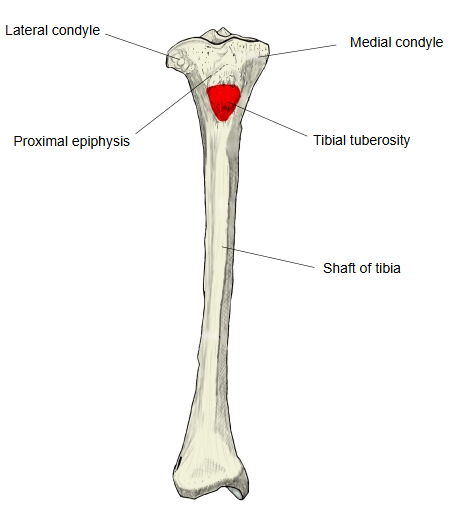
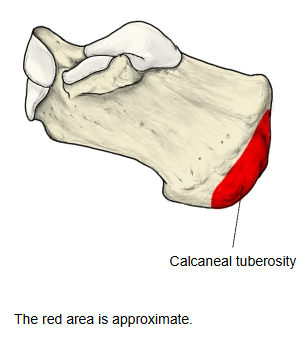
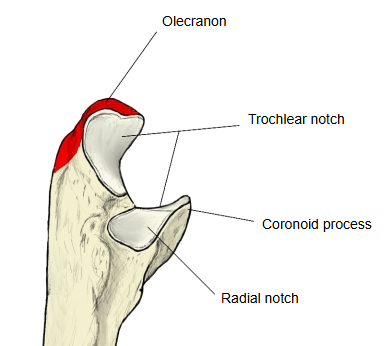
Projections often described as apophyses are the tibial tuberosity, which receives the patellar ligament; the calcaneal tuberosity, which receives the calcaneal tendon; the olecranon, which receives the triceps brachii; and the greater trochanter of the femur.
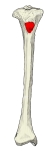 Tibial tuberosity (anterior)
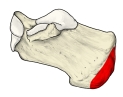 Calcaneal tuberosity
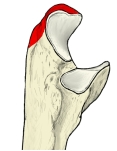 Olecranon of ulna
Related terms
References and sources
- Further reading: Anatomical terms of bone, Wikipedia.
- Federative International Programme for Anatomical Terminology (FIPAT). Terminologia Anatomica, 2nd ed. (TA2), 2019.