Calcaneal tuberosity (Latin: tuber calcanei)
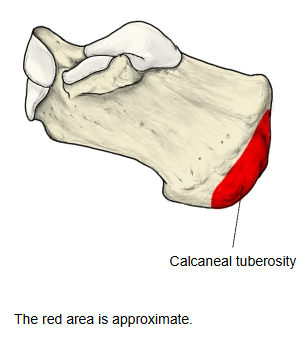
Anatomy textbooks describe it as follows.
The thick back part of the calcaneus is the body of the calcaneus, and the prominence that projects backwards from it is the calcaneal tuberosity. The calcaneal tendon, the tendon of triceps surae (the Achilles tendon), attaches to its rough surface. The plantar (under) side of the tuberosity carries two processes, the medial process and the lateral process, which take weight in standing. From these processes arise abductor hallucis, flexor digitorum brevis and abductor digiti minimi, and the plantar aponeurosis. The long plantar ligament arises from the plantar surface in front of the processes.
Another anatomy text adds the following.
The back half of the calcaneus is a large mass of bone that juts out backwards. This part, the calcaneal tuberosity, makes up most of the heel. Its posterior surface has three zones: a smooth upper zone, separated from the tendon by a bursa; a rough middle zone, crossed by transverse ridges, where the Achilles tendon attaches; and a lower zone covered by the fat pad of the heel.
Where it is found
Related terms
- Body of calcaneus
- Medial process of calcaneal tuberosity
- Lateral process of calcaneal tuberosity
- Calcaneal tubercle
- Sustentaculum tali
- Calcaneus
References and sources
- Further reading: Calcaneus, Wikipedia.
- Further reading: Achilles tendon, Wikipedia.
- Federative International Programme for Anatomical Terminology (FIPAT). Terminologia Anatomica, 2nd ed. (TA2), 2019.