Arachnoid granulations (Latin: granulationes arachnoideae)
Also called Pacchionian granulations (bodies)
What are arachnoid granulations?
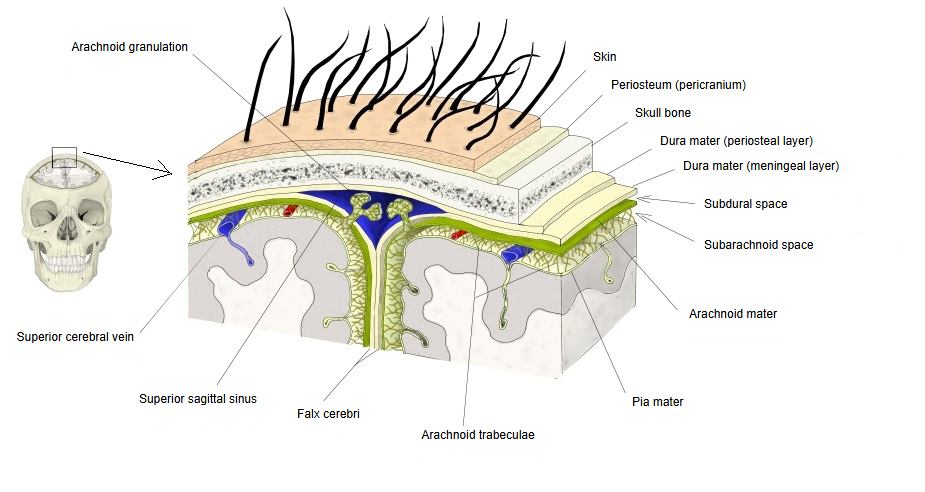
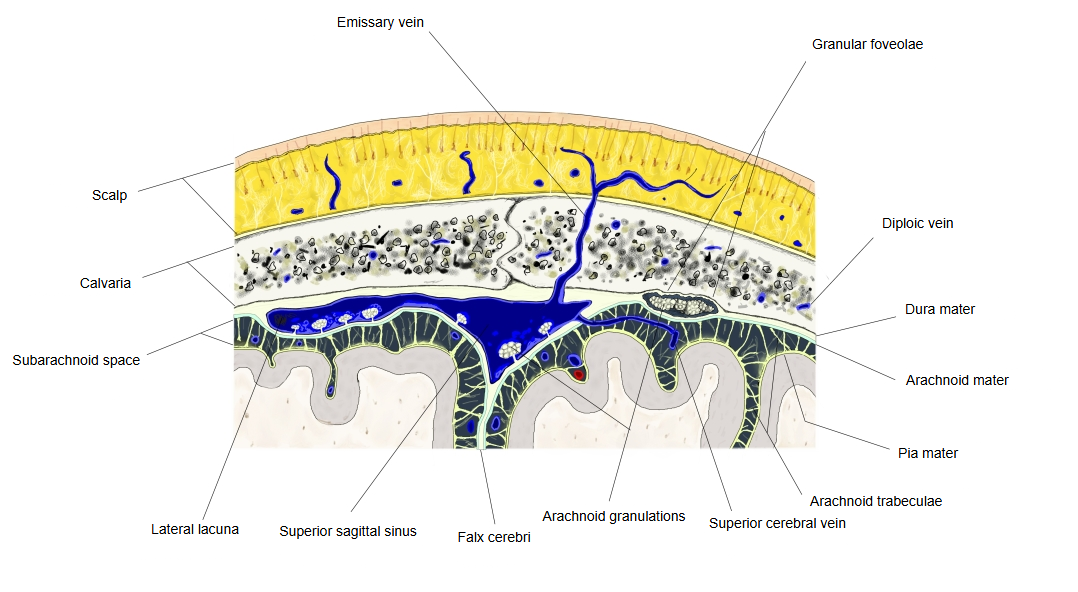
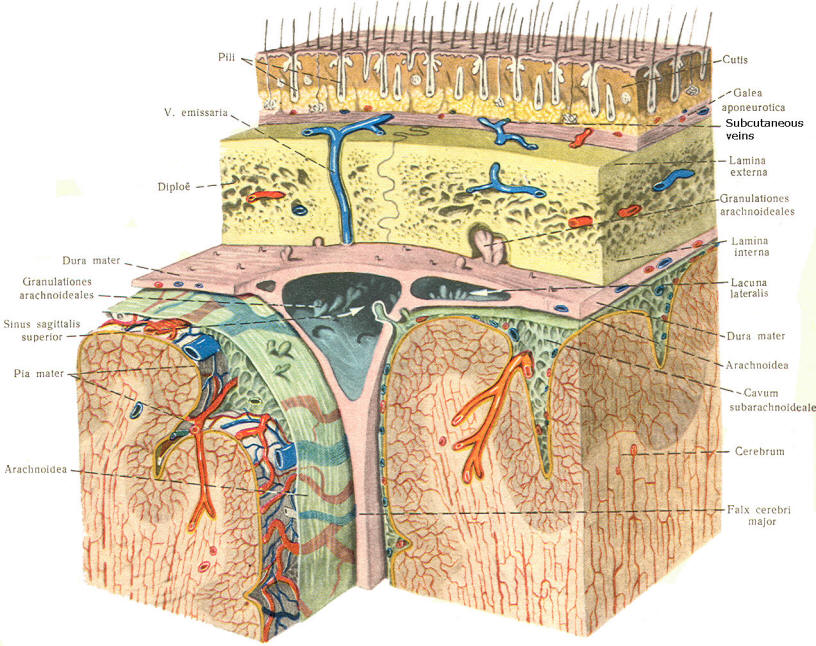
· Near the venous sinuses, and especially near the superior sagittal sinus, the outer surface of the arachnoid sends out cauliflower-like projections of various sizes, whose tips push through the dura into the dural venous sinuses and their lateral lacunae. They are largest and most numerous along the superior sagittal sinus but also occur on other sinuses.
· They enlarge with age and may calcify. Large granulations sometimes reach the inner surface of the skull and press small pits into it, the granular foveolae.
· Each granulation is a cluster of arachnoid villi: its core is a continuation of the subarachnoid space crossed by many connective tissue strands (arachnoid trabeculae), covered by arachnoid cells and the endothelium of the sinus. Sources differ in wording: many texts use arachnoid granulations and arachnoid villi as the same thing, while others keep villi for the microscopic projections and granulations for the larger clusters.
· Function: they are a route by which cerebrospinal fluid passes from the subarachnoid space out into the venous blood, especially of the dural venous sinuses. Flow is one-way, driven by the higher pressure of the fluid. Sources differ on how much drainage also goes by lymphatic routes along the cranial nerves.
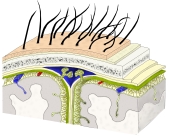 Layers from scalp to brain
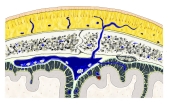 Arachnoid granulations
Reference websites
[Wikipedia]
· Arachnoid granulation, Wikipedia.
[Websites with illustrations]
· Meninges and superior sagittal sinus with arachnoid granulations (Netter) (Netter Images)

· Layers from the scalp to the brain, with arachnoid granulations in the lateral lacunae (Latin labels) (humanneurophysiology.com)
Related terms
- Granular foveolae
- Dura mater
- Subdural space
- Superior sagittal sinus
- Lateral lacunae
- Dural venous sinuses
- Choroid plexus
References and sources
- Further reading: Arachnoid granulation, Wikipedia.
- Federative International Programme for Anatomical Terminology (FIPAT). Terminologia Anatomica, 2nd ed. (TA2), 2019.