Arachnoid mater (Latin: arachnoidea mater)
Also called Arachnoid or the arachnoid membrane
· Overview
Overview
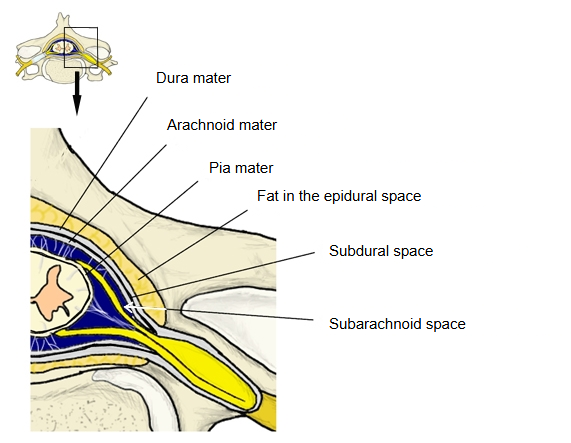
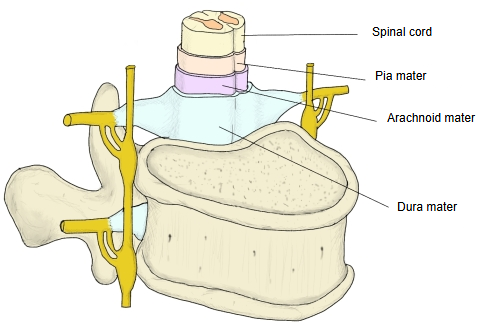
- Dura mater : the outermost and toughest membrane.
- Arachnoid mater : the membrane between the dura mater and the pia mater; it has no blood vessels.
- Pia mater : the innermost, very thin membrane on the surface of the brain and spinal cord; it is made of an inner and an outer layer.
- Epidural (extradural) space : the space between the spinal dura mater and the wall of the vertebral canal.
- Dura mater
- Subdural space : normally only a potential space; it opens up only in disease or after injury.
- Arachnoid mater
- Subarachnoid space : filled with cerebrospinal fluid; it widens into the subarachnoid cisterns.
- Pia mater
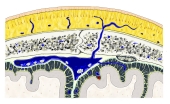 Meninges of the brain
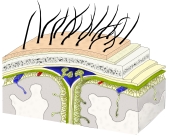 Layers from scalp to brain
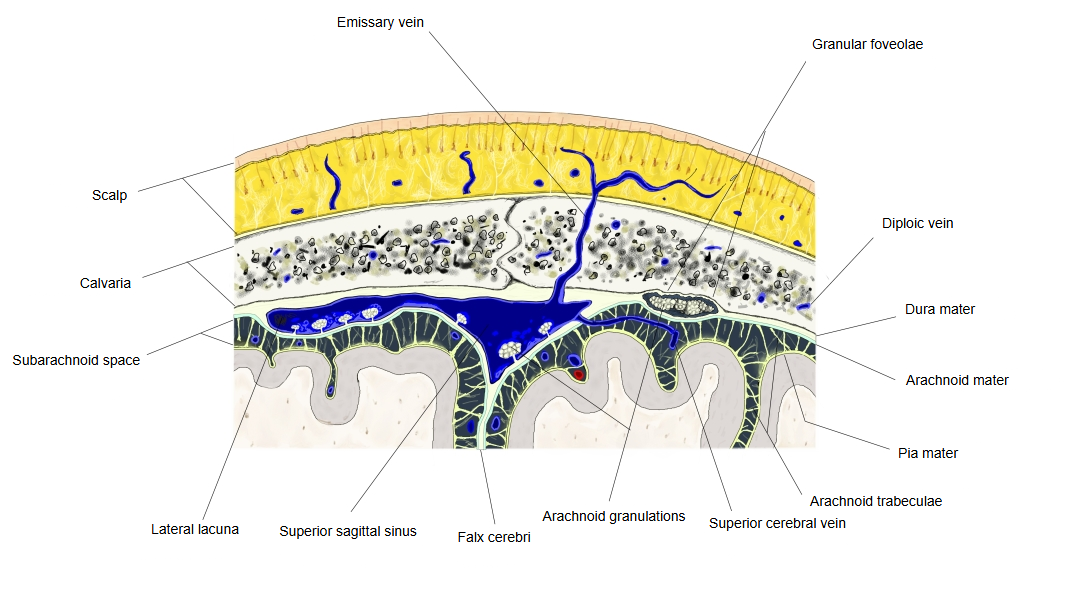
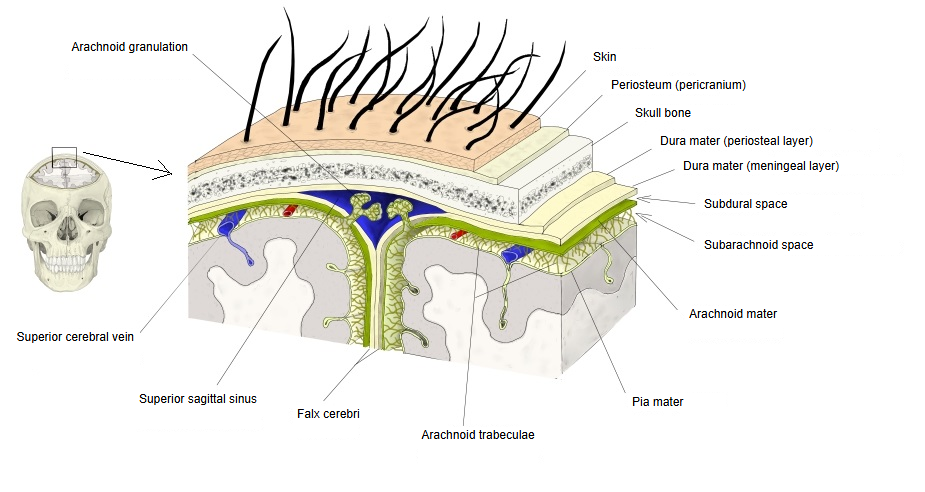
Cranial arachnoid mater
The cranial arachnoid mater is a thin membrane of connective tissue without blood vessels. Between it and the cranial dura mater lies a narrow space, the subdural space, which is normally only a potential space. Between it and the pia mater lies a wider space, the subarachnoid space, filled with cerebrospinal fluid. The subarachnoid space communicates with the ventricles through three openings in the roof of the fourth ventricle: the median aperture and the two lateral apertures of the fourth ventricle. As in the spinal cord, many fine connective-tissue strands, the arachnoid trabeculae, run like a spider's web from the arachnoid to the pia mater. The arachnoid does not dip into the sulci of the cerebrum and cerebellum, so the subarachnoid space is a little wider over each sulcus; at several places, mainly at the base of the brain, it widens much more into the subarachnoid cisterns.
The cranial arachnoid mater is the upward continuation of the spinal arachnoid mater. The trabeculae make the subarachnoid space a network filled with cerebrospinal fluid. The pia mater follows the whole surface of the brain, while the arachnoid bridges over every sulcus except the longitudinal fissure, where it follows the falx cerebri down; so over the convex surface of the gyri the two membranes lie close together. Arachnoid granulations push into the dural venous sinuses, especially the superior sagittal sinus, and return cerebrospinal fluid to the venous blood.
Spinal arachnoid mater
The spinal arachnoid mater is a thin membrane of connective tissue without blood vessels between the dura mater and the pia mater; it continues the cranial arachnoid down the vertebral canal, lining the dural sac to about the level of the second sacral vertebra. Many fine connective-tissue strands run from its inner surface to the pia mater like a spider's web. In the lower cervical and the thoracic regions they form a lengthwise sheet, the subarachnoid septum, between the inner surface of the arachnoid and the posterior median sulcus of the spinal cord. The very narrow space between the dura mater and the arachnoid is the subdural space; the wide space between the arachnoid and the pia mater is the subarachnoid space, filled with cerebrospinal fluid.
The strands between the arachnoid and the pia mater are covered by flat endothelium-like cells. From the neck to the chest they are numerous and strong along the back of the cord and form a continuous midline sheet, the intermediate cervical septum (posterior subarachnoid septum). The spinal subarachnoid space forms no cisterns like those of the brain, except that below the end of the spinal cord (about L1–L2) it widens into the lumbar cistern. This space is used for lumbar puncture, which is done below the medullary cone, usually between L3 and L4 or L4 and L5, to avoid injuring the cord. The level is found with Jacoby's line (supracristal line), the line joining the highest points of the right and left iliac crests, which lies at about the spinous process of the fourth lumbar vertebra.
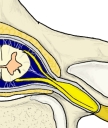 Meninges of the spinal cord
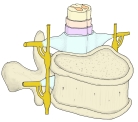 Spinal cord and its coverings
Reference websites
[Wikipedia]
· Arachnoid mater, Wikipedia.
· Meninges, Wikipedia.
[Websites with illustrations]
· Cranial meninges from scalp to cortex (figure) (WordPress (McGraw-Hill figure))

· Dura mater of the brain (specimen photograph) (Wikimedia Commons)

· Human brain with dura mater (specimen photograph) (Wikimedia Commons)

Related terms
References and sources
- Further reading: Arachnoid mater, Wikipedia.
- Further reading: Meninges, Wikipedia.
- Federative International Programme for Anatomical Terminology (FIPAT). Terminologia Anatomica, 2nd ed. (TA2), 2019.