Arterial rete mirabile
Overview
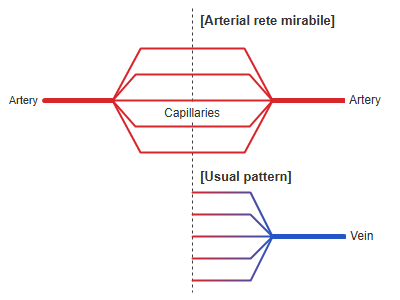
· There are two kinds of rete mirabile (wonderful net): the arterial rete mirabile and the venous rete mirabile.
The two kinds are summarized below.
- Arterial rete mirabile : arteriole → capillary network → arteriole. Example: the glomerulus of the kidney (the human example).
- Venous rete mirabile : vein → capillary network → vein. Example: the capillaries of the liver (sinusoids).
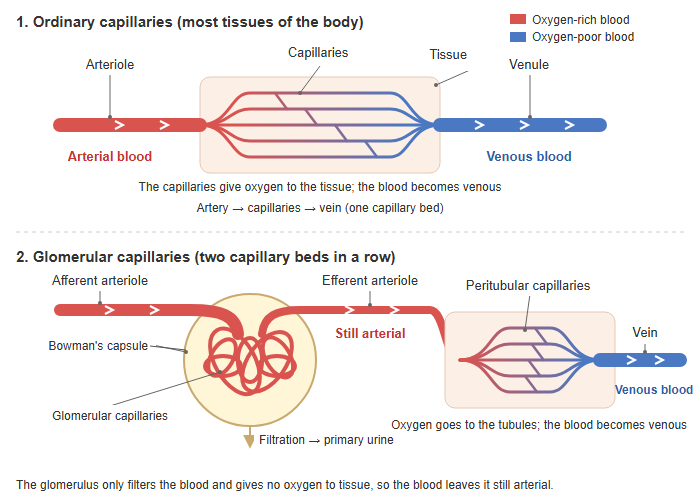
· In an ordinary capillary bed blood flows arteriole → capillaries → venule. In an arterial rete mirabile the vessel that drains the capillary network is again an arteriole.
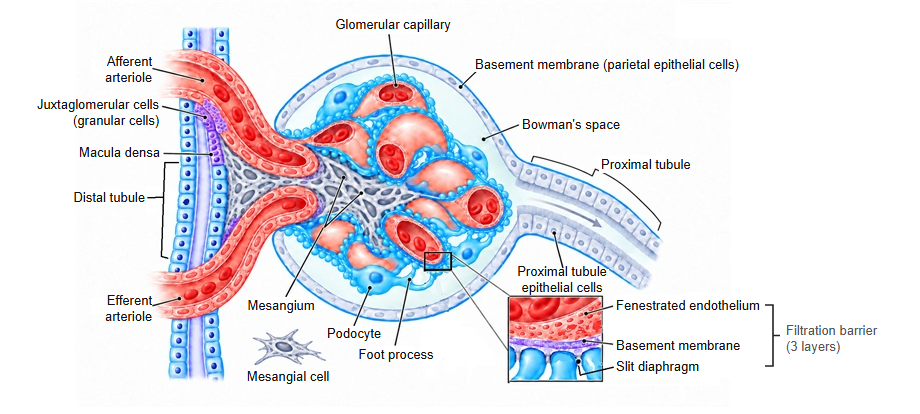
· The afferent arteriole that enters the renal corpuscle breaks up into the capillary network of the glomerulus (the glomerular capillaries), which join again into the efferent arteriole and leave the corpuscle. The place where the afferent and efferent arterioles enter and leave is the vascular pole.
· Because the outflow is the high-resistance efferent arteriole, the pressure inside the glomerular capillaries stays high. This pressure filters plasma into Bowman's capsule, forming the primary urine. The efferent arteriole then forms a second capillary network around the tubules (peritubular capillaries; vasa recta in the medulla) before the blood passes into the veins.
· By contrast, a capillary network placed between two veins is a venous rete mirabile; the usual example is the capillaries of the liver (sinusoids), which lie between the portal vein and the hepatic veins.
· In some animals, such as cattle and sheep, the arteries to the brain form a network of fine arteries at the base of the skull that join again (the carotid rete mirabile). Humans do not have it.
· Classical anatomy describes the rete mirabile as a capillary network inserted either on the arterial side of the main capillary bed (arterial rete, as in the glomerulus) or on its venous side (venous rete, as in the liver).
· Older textbooks describe it as an artery that suddenly splits into a bundle of fine branches, which join one another and gather again into a single artery, as in the glomerulus of the kidney.
· The Latin name rete mirabile means "wonderful net". In comparative biology the term is often used for networks in which arteries and veins run side by side and exchange heat or gases by countercurrent exchange.
Reference websites
[Wikipedia]
· Rete mirabile, Wikipedia.
· Glomerulus (kidney), Wikipedia.
[Websites with illustrations]
· Renal corpuscle (diagram) (Wikimedia Commons)

· Glomerulus, Gray's Anatomy figure 1130 (Wikimedia Commons)

· The glomerulus (TeachMePhysiology)
Related terms
References and sources
- Further reading: Rete mirabile, Wikipedia.
- Further reading: Glomerulus (kidney), Wikipedia.
- Federative International Programme for Anatomical Terminology (FIPAT). Terminologia Anatomica, 2nd ed. (TA2), 2019.