Articular head
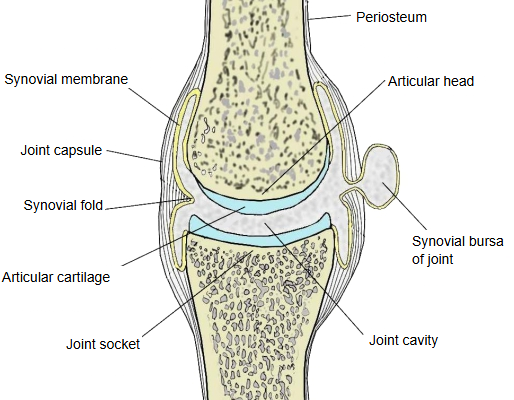
The articular head is the part of a bone in a joint that is convex and fits into the concave socket of the other bone.
⇒ Main parts of a movable (synovial) joint
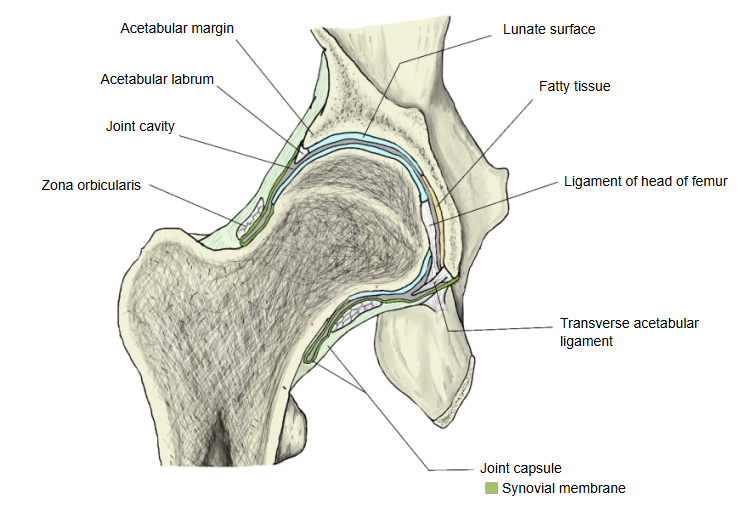
In most synovial joints one articular surface is convex (the head) and the other is concave (the socket or fossa). Like the socket, the head is covered with articular cartilage; it is usually larger in area than the socket, which lets it roll and glide over it. Examples are the head of the femur in the acetabulum (hip joint), the head of the humerus on the glenoid cavity (shoulder joint) and the head of the mandible in the mandibular fossa (temporomandibular joint). 'Articular head' is a general descriptive term, not a name in the official anatomical terminology.
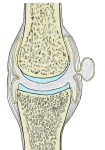 Model of a synovial joint
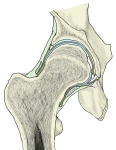 Hip joint (coronal section)
Related terms
- Head of femur
- Head of humerus
- Head of mandible
- Glenoid cavity
- Hip joint
- Glenohumeral joint
- Temporomandibular joint
References and sources
- Further reading: Synovial joint, Wikipedia.
- Federative International Programme for Anatomical Terminology (FIPAT). Terminologia Anatomica, 2nd ed. (TA2), 2019.