Mandibular fossa (Latin: fossa mandibularis)
Also called the glenoid fossa (in dental usage)
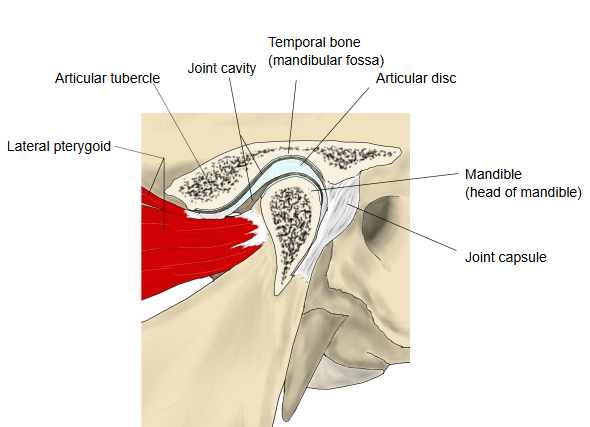
· Between the mandibular fossa and the head of the mandible lies an articular disc; around its edge the disc is firmly fused with the joint capsule.
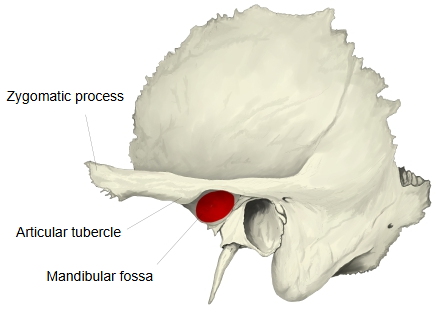
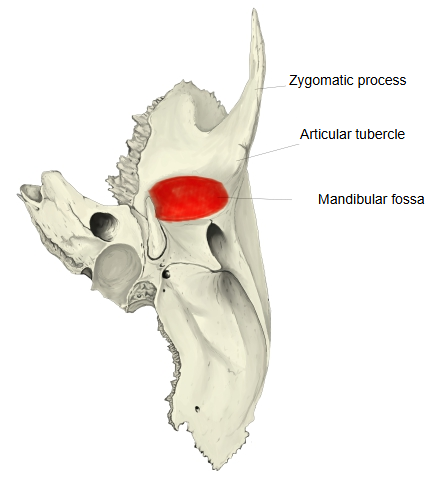
The fossa is an oval hollow on the underside of the temporal bone, just in front of the external acoustic meatus. It is bounded in front by the articular tubercle and behind by the tympanic part, which separates it from the external acoustic meatus.
The squamotympanic fissure crosses it (medially it is split by the edge of the tegmen tympani into the petrosquamous and petrotympanic fissures): the front part, on the squamous part, is the articular surface, while the back part, formed by the tympanic part, is non-articular.
Its roof is thin bone that separates the joint from the middle cranial fossa.
- Squamous part : the part that takes up the middle and the whole upper part of the bone; it has a temporal surface and a cerebral surface. Related terms: groove for the middle temporal artery, zygomatic process (articular tubercle), suprameatal spine.
- Petrous part : the lower part, in two parts: the mastoid part (from the mastoid process to the parietal notch) and the pyramid (part of the cranial base).
- Tympanic part : the smallest part: a thin, half-tube-shaped plate of bone that forms the front and lower walls of the external acoustic meatus.
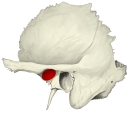 Left temporal bone (lateral view)
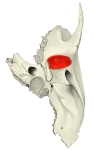 Left temporal bone (inferior view)
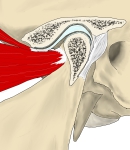 Left temporomandibular joint (section)
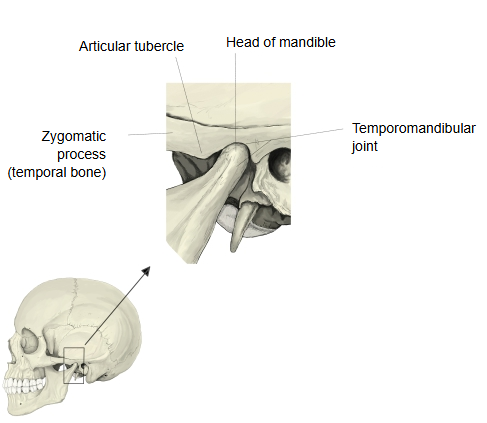
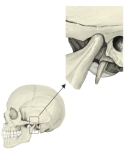 Left temporomandibular joint
Reference websites
[Wikipedia]
· Mandibular fossa, Wikipedia.
[Websites with illustrations]
· Left temporal bone, outer surface (Gray's Anatomy, fig. 137) (Wikimedia Commons)

· Glenoid (mandibular) fossa of the right side (Gray's Anatomy, fig. 328) (Wikimedia Commons)

· The temporomandibular joint (TeachMeAnatomy)
Related terms
- Temporomandibular joint
- Articular tubercle
- Head of mandible
- Condylar process
- Articular disc
- Petrotympanic fissure
- Temporal bone
References and sources
- Further reading: Mandibular fossa, Wikipedia.
- Federative International Programme for Anatomical Terminology (FIPAT). Terminologia Anatomica, 2nd ed. (TA2), 2019.