Base of cochlea (Latin: basis cochleae)
The cochlea has the shape of a cone: its tip is called the cochlear cupula (apex) and its broad bottom the base of the cochlea.
Cochlea: one of the parts of the internal ear (the organ of hearing)Base: about 8-9 mm across
· The base of the cochlea is pierced by the fibres of the cochlear nerve.
The cochlear cupula points forwards and laterally in the skull, and the base of the cochlea faces backwards and medially, towards the internal acoustic meatus.
Internal acoustic meatus: a canal in the temporal bone, about 1 cm long, that carries nerves and vessels
 Inner ear in the temporal bone (superior view)
 Cochlea (section)
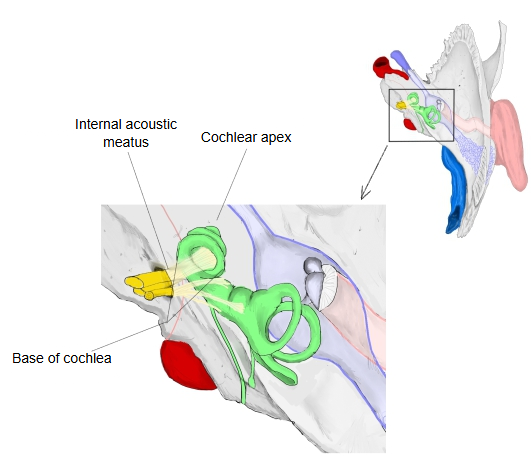
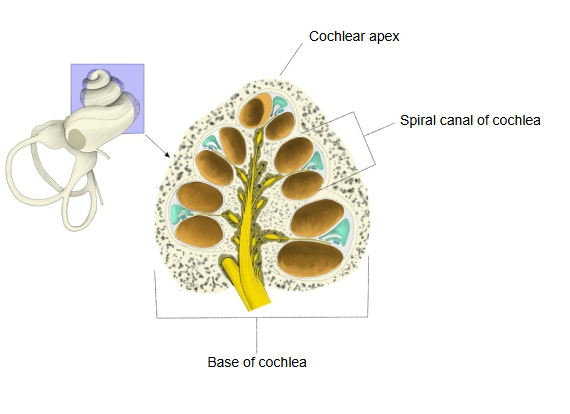
The base of the cochlea lies against the fundus of the internal acoustic meatus. At its centre is the base of the modiolus, which matches the cochlear area of the fundus; it is perforated by many small holes through which the fibres of the cochlear nerve enter the modiolus on their way to the cochlear duct. The cochlea is part of the bony labyrinth.
Related terms
References and sources
- Further reading: Cochlea, Wikipedia.
- Federative International Programme for Anatomical Terminology (FIPAT). Terminologia Anatomica, 2nd ed. (TA2), 2019.