Calcium phosphate
Overview
Calcium phosphate is the general name for the salts made of calcium ions and phosphate ions.
Salt: a compound of positive ions (cations) and negative ions (anions).Phosphate ions here include diphosphate (pyrophosphate) ions.
· In the narrow sense, the name means tricalcium phosphate.
The table below lists examples of calcium phosphates.
Several compounds are called calcium phosphates; they differ in the ratio of calcium ions to phosphate ions. In general, the salts that are stable in acidic conditions have a lower calcium-to-phosphate ratio.
| 1 | Monocalcium phosphate (calcium dihydrogen phosphate), Ca(H2PO4)2 | 6 | Fluorapatite, Ca10(PO4)6F2 (fluoride in place of hydroxide) |
| 2 | Dicalcium phosphate (calcium hydrogen phosphate), CaHPO4 | 7 | Chlorapatite, Ca10(PO4)6Cl2 (chloride in place of hydroxide) |
| 3 | Tricalcium phosphate, Ca3(PO4)2 | 8 | Carbonate apatite |
| 4 | Octacalcium phosphate | 9 | Whitlockite |
| 5 | Hydroxyapatite, Ca10(PO4)6(OH)2 (abbreviated HAP, HAp or OHAp; also called hydroxylapatite; the mineral is a form of apatite) |
Calcium phosphate in the body
Bone
About 70% of the weight of bone is calcium phosphate in the form of hydroxyapatite.
Sources differ somewhat in the proportion.
The chart below shows the main components of bone. It was drawn from several sources, so the proportions may differ from the figure above; they also vary with whether wet or dry weight is meant.
Components
of bone
of bone
Teeth
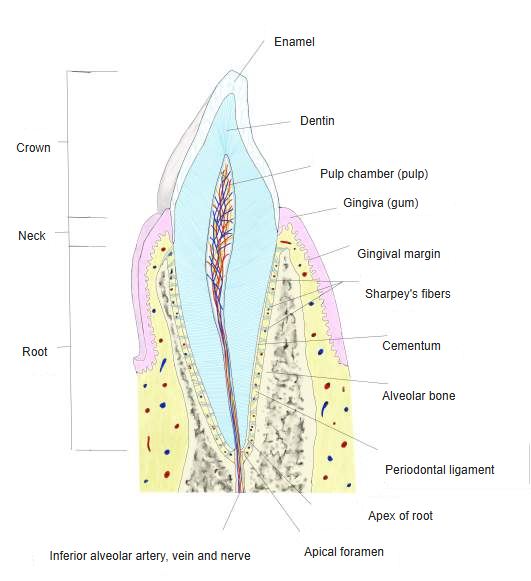
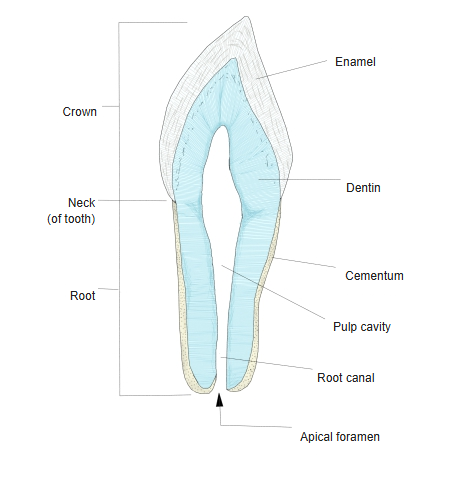
The hard tissues of the teeth are also made mostly of hydroxyapatite, a kind of calcium phosphate.
Structure
of a tooth
of a tooth
- Enamel : about 96% mineral by weight, mainly hydroxyapatite; the hardest tissue of the bodythe hard substance covering the crown
- Dentin : about 70% inorganic material by weight, mainly hydroxyapatitethe hard tissue that forms the bulk of the tooth
- Cementum : about half inorganic material by weight, mainly hydroxyapatitethe hard tissue covering the root
- Pulp cavity : filled with the dental pulp, which contains blood vessels and nervesthe space in the middle of the tooth
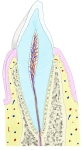 Mandibular incisor (sagittal section)
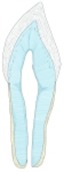 Structure of a tooth
Reference websites
[Wikipedia]
· Calcium phosphate, Wikipedia.
Related terms
References and sources
- Further reading: Calcium phosphate, Wikipedia.
- Federative International Programme for Anatomical Terminology (FIPAT). Terminologia Anatomica, 2nd ed. (TA2), 2019.