Enamel (Latin: enamelum)
Also called the tooth enamel
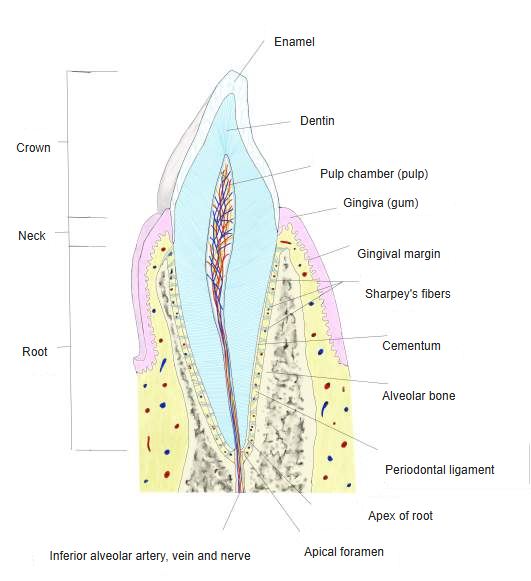
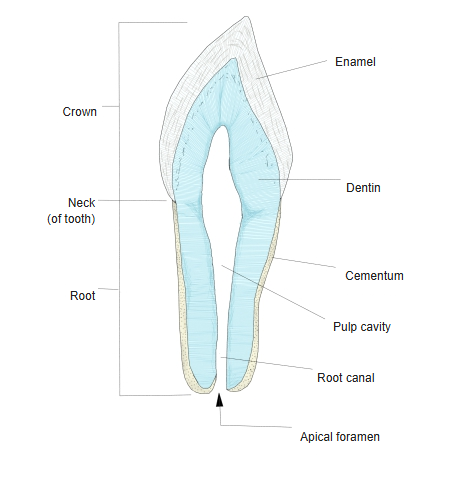
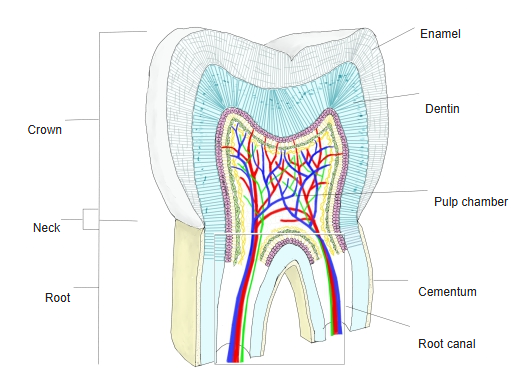
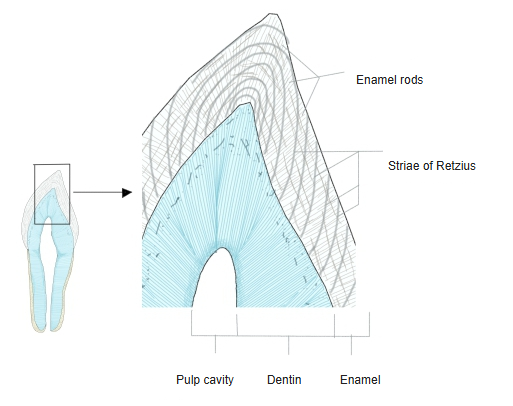
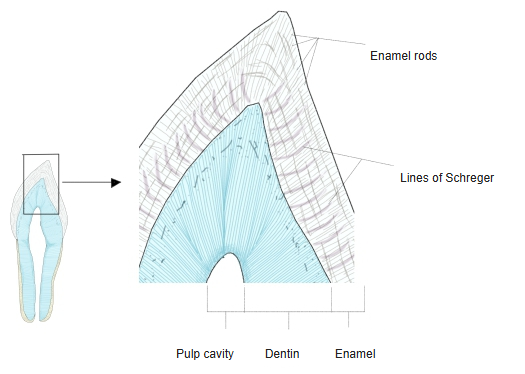
The hard, white outer layer that covers the dentine of the crown of a tooth; it is the hardest tissue in the body. With dentine and cementum it is one of the three hard tissues of a tooth. It is thickest over the cusps (up to about 2.5 mm) and thins out towards the neck of the tooth, where it meets the cementum. It is almost entirely mineral (about 96%), mostly hydroxyapatite crystals, with very little organic matter and water. Its basic units are the enamel rods, which run from the dentinoenamel junction to the surface; each rod is wrapped in an enamel sheath, and the interprismatic substance fills the spaces between rods. Growth lines show as the striae of Retzius; groups of rods bending in alternate directions show as the Hunter–Schreger bands. A newly erupted tooth is covered by a thin dental cuticle. Enamel is made by ameloblasts, which are lost once the tooth erupts, so enamel cannot repair itself.
See "Enamel" on the Teeth page.
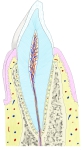 Mandibular incisor (sagittal section)
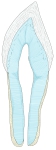 Structure of a tooth
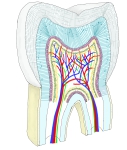 Molar (section)
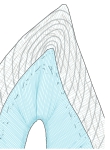 Striae of Retzius
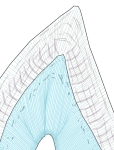 Hunter–Schreger bands
Related terms
References and sources
- Further reading: Tooth enamel, Wikipedia.
- Federative International Programme for Anatomical Terminology (FIPAT). Terminologia Anatomica, 2nd ed. (TA2), 2019.