Canals of Lambert
Also called the channels of Lambert or the bronchiole–alveolar communications or the singular canal of Lambert
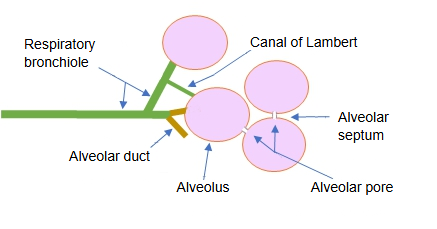
The canals of Lambert (channels of Lambert) are microscopic accessory passages, lined by epithelium, that run from the terminal and respiratory bronchioles into adjacent alveoli, bypassing the normal route through the alveolar ducts and alveolar sacs. Together with the alveolar pores (pores of Kohn), and the less certain interbronchiolar channels of Martin, they provide collateral ventilation: air can reach alveoli whose own airway is blocked. They are poorly developed in young children; this, with the scarcity of alveolar pores, is thought to explain why pneumonia in children often stays as a well-defined rounded focus (round pneumonia). They are named after Margaret Lambert, who described them in 1955.
Reference websites
[Wikipedia]
· Pulmonary alveolus, Wikipedia.
· Pores of Kohn, Wikipedia.
Related terms
- Alveolar pores
- Respiratory bronchiole
- Terminal bronchiole
- Bronchiole
- Alveolar duct
- Alveolar sac
- Lung
References and sources
- Further reading: Pulmonary alveolus, Wikipedia.
- Further reading: Pores of Kohn, Wikipedia.
- Federative International Programme for Anatomical Terminology (FIPAT). Terminologia Anatomica, 2nd ed. (TA2), 2019.