Cartilage endplate
Also called: cartilaginous endplate; vertebral endplate (cartilage part)
· The name is not listed as a separate term in Terminologia Anatomica, but it is a common term in spine research and clinical texts.
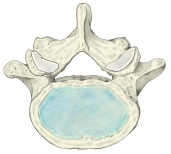 Fifth lumbar vertebra, upper surface
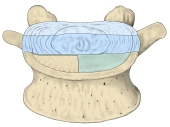 Vertebral body and intervertebral disc
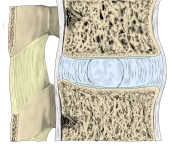 Section through an intervertebral disc
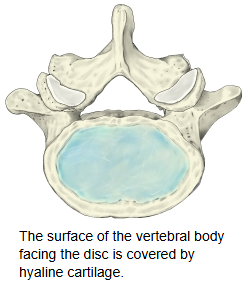
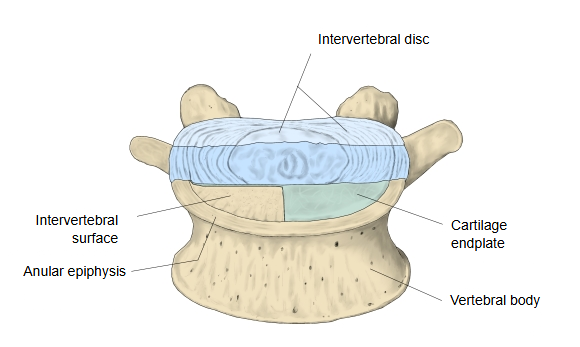
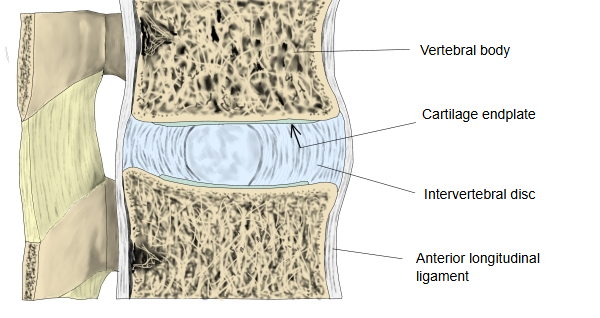
It is a thin layer of cartilage, about 0.5–2 mm thick (sources differ), that covers the upper and lower bony surfaces of the vertebral body except at the rim, the anular epiphysis. It covers the whole upper and lower surface of the nucleus pulposus but only the inner layers of the anulus fibrosus. The adult disc has almost no blood vessels of its own: nutrients, especially for the nucleus pulposus and the inner anulus, pass by diffusion from the vessels of the vertebral body through the endplate, so it is the main nutrient route of the disc.
It is a thin horizontal layer of hyaline cartilage that occupies most of the central part of the interface between the disc and the vertebral body. As the skeleton matures it regresses, and in the adult it is a layer of hyaline cartilage with calcified cartilage next to the bone. With age it thins and partly calcifies, which reduces the diffusion of nutrients into the disc.
Related terms
- Intervertebral disc
- Vertebral body
- Anular epiphysis
- Hyaline cartilage
- Intervertebral symphysis
- Cartilaginous joint
- Vertebra
References and sources
- Further reading: Vertebral end plate, Wikipedia.
- Further reading: Intervertebral disc, Wikipedia.
- Federative International Programme for Anatomical Terminology (FIPAT). Terminologia Anatomica, 2nd ed. (TA2), 2019.