Clinical crown (Latin: corona clinica)
Also called the clinical crown of tooth
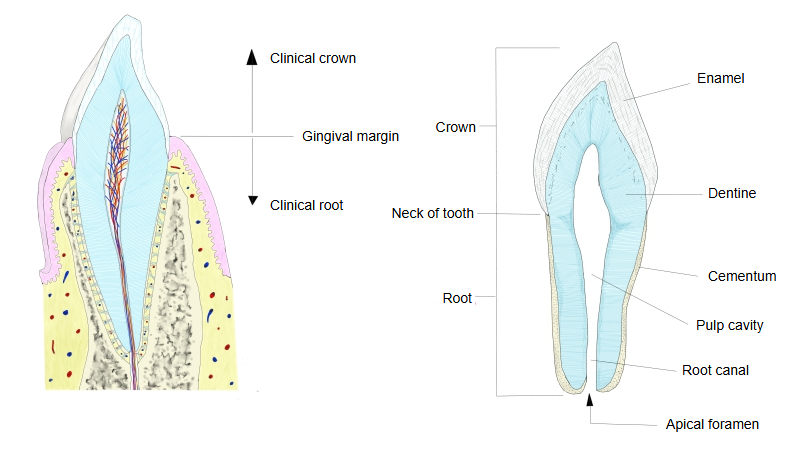
The clinical crown is the part of a tooth projecting above the gingival margin (the edge of the gum).
In other words, it covers a slightly different extent from the anatomical crown of the tooth on its own (the part covered with enamel).
The part below the gingival margin, hidden by the gum and the bone of the tooth socket, is the clinical root; it likewise differs from the anatomical root, the part covered with cementum. In a tooth that is still erupting the clinical crown is shorter than the anatomical crown; when the gum recedes with age or periodontal disease, part of the root is exposed and the clinical crown becomes longer. The anatomical crown and root meet at the neck (cementoenamel junction).
Related terms
References and sources
- Further reading: Crown (tooth), Wikipedia.
- Further reading: Gums, Wikipedia.
- Federative International Programme for Anatomical Terminology (FIPAT). Terminologia Anatomica, 2nd ed. (TA2), 2019.