Interstitial fluid
Also called: tissue fluid; intercellular fluid
Overview
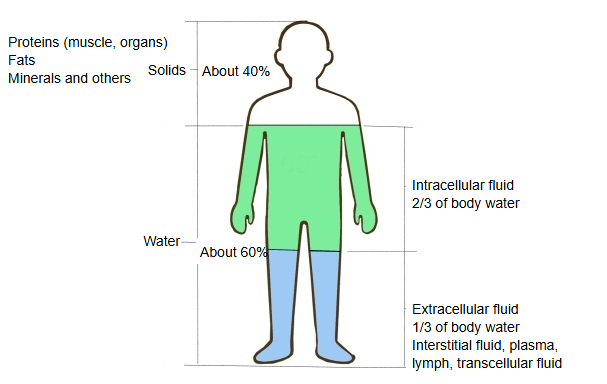
- Intracellular fluid : the fluid inside cells; about 2/3 of body water, about 40% of body weight. Some sources do not count it as body fluid.
- Extracellular fluid : about 1/3 of body water.
- Interstitial fluid : about 70-75% of the extracellular fluid; lies around the cells (between cells, and between cells and capillaries).
- Plasma : about 20-25%; the fluid part of blood, without the blood cells (red and white blood cells etc.).
- Lymph : about 1-2%; the part of the interstitial fluid that has entered the lymphatic vessels.
- Transcellular fluid : about 1-2%; special fluids enclosed by epithelial cells, such as cerebrospinal fluid and synovial fluid. Some sources do not count it as extracellular fluid.
Features
1. 1. Plasma that has seeped out of the capillaries
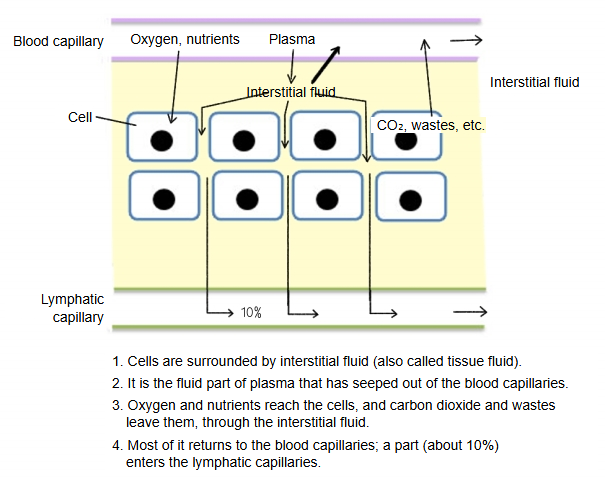
It is formed from the fluid part of plasma (see blood) pushed out through the walls of the blood capillaries by blood pressure, so plasma is its source and it contains, in solution:
· amino acids, sugars (such as glucose), fatty acids, hormones, neurotransmitters, salts (electrolytes) and other small molecules. White blood cells, including lymphocytes, can also leave the vessels actively and move through it.
Note: red blood cells, platelets and most plasma proteins cannot pass through the capillary wall.
2. 2. About 15% of body weight
The extracellular fluid consists mainly of plasma (see blood) and interstitial fluid. Plasma is about 5% of body weight and interstitial fluid about 15%, so there is about three times as much interstitial fluid as plasma.
3. 3. Go-between for substances
Oxygen and nutrients brought by the blood capillaries leave them and travel through the interstitial fluid to the cells. Carbon dioxide and wastes produced in the cells travel back through the interstitial fluid to the capillaries and are carried away.
4. 4. Part of it flows into the lymphatic capillaries
Most of the interstitial fluid around the cells (classically about 90%) returns to the blood capillaries, and a part (about 10%) flows into the lymphatic capillaries and becomes lymph. Sources differ on these proportions.
Reference websites
[Wikipedia]
· Extracellular fluid, Wikipedia.
· Lymph, Wikipedia.
Related terms
- Extracellular fluid
- Body fluid
- Intracellular fluid
- Transcellular fluid
- Blood
- Loose connective tissue
References and sources
- Further reading: Extracellular fluid, Wikipedia.
- Federative International Programme for Anatomical Terminology (FIPAT). Terminologia Anatomica, 2nd ed. (TA2), 2019.