Fissure for ligamentum teres (Latin: fissura ligamenti teretis)
Also called the umbilical fissure
· It is the same part as the umbilical groove, in which the umbilical vein runs in the fetus (from about the 9th week of pregnancy until birth). Sources differ in their use of "umbilical fissure": some use it as another name for this fissure, others keep "umbilical groove" for the fetal groove of the umbilical vein.
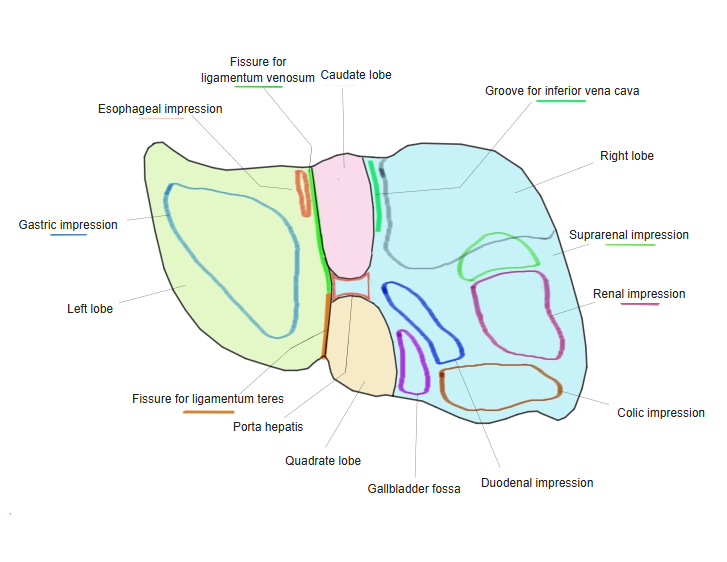
- Fissure for ligamentum teres : front part: the groove in which the round ligament of liver (fibrous remnant of the fetal umbilical vein) runs.
- Fissure for ligamentum venosum : back part: the groove in which the ligamentum venosum (fibrous remnant of the fetal ductus venosus) runs.
Note: some sources describe the left sagittal fossa as the fissure for the ligamentum teres + the left end of the porta hepatis + the fissure for the ligamentum venosum.
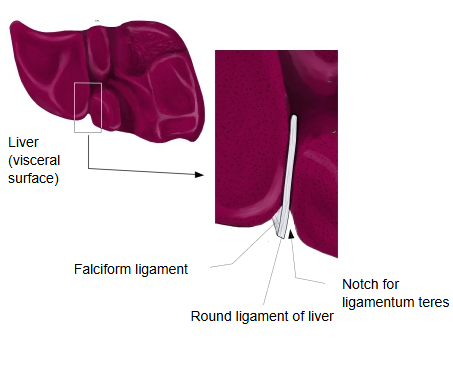
· The fissure lies between the left lobe and the quadrate lobe. In front it starts at the notch for the ligamentum teres on the inferior border, where the round ligament enters the liver in the free edge of the falciform ligament. At its back end the round ligament joins the left branch of the portal vein, and behind the left end of the porta hepatis the fissure for the ligamentum venosum continues it.
· A bridge of liver tissue (pons hepatis) often crosses part of the fissure and turns it into a short tunnel.
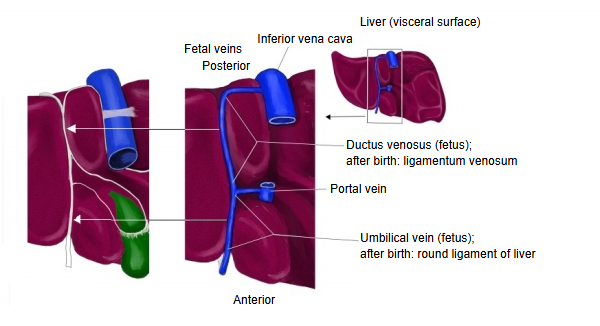
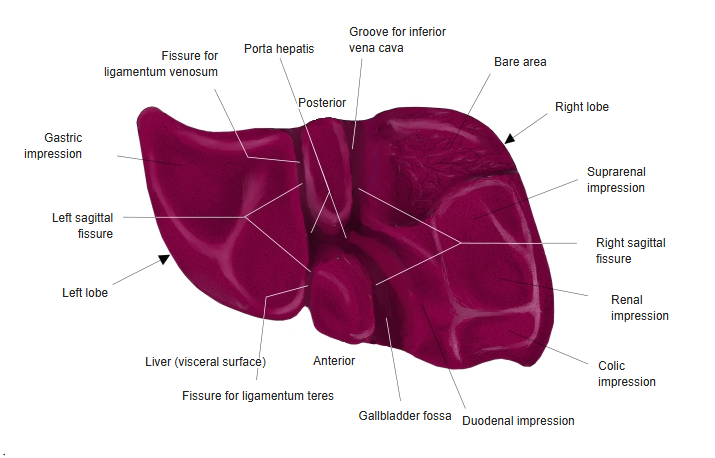
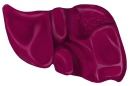 Liver (visceral surface)
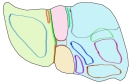 Features of the visceral surface
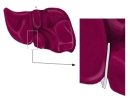 Notch for ligamentum teres
Reference websites
[Wikipedia]
· Round ligament of liver, Wikipedia.
· Liver, Wikipedia.
[Websites with illustrations]
· Fissure for ligamentum teres (IMAIOS e-Anatomy)
· Visceral surface of the liver (Jaypee (textbook figure))

Where it is found
Related terms
- Round ligament of liver
- Fissure for ligamentum venosum
- Ligamentum venosum
- Quadrate lobe
- Left lobe of liver
- Porta hepatis
- Liver
References and sources
- Further reading: Round ligament of liver, Wikipedia.
- Further reading: Liver, Wikipedia.
- Federative International Programme for Anatomical Terminology (FIPAT). Terminologia Anatomica, 2nd ed. (TA2), 2019.