Ligamentum venosum (Latin: ligamentum venosum)
Also called the venous ligament
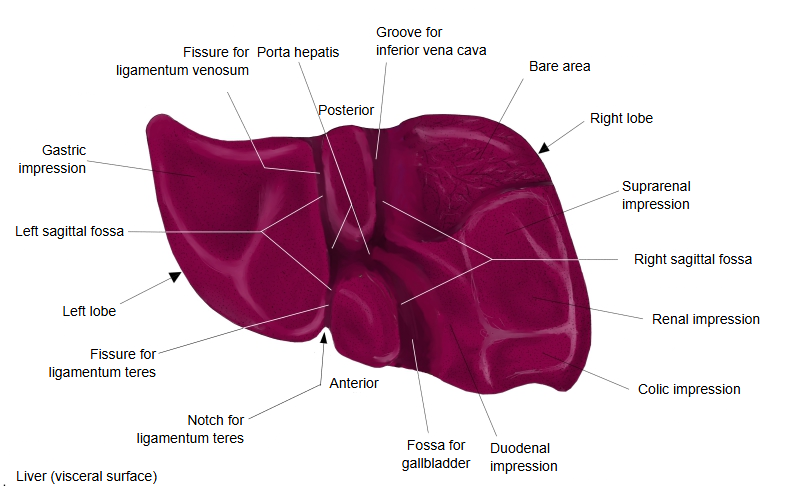
· It lies in the depth of the fissure, between the caudate lobe and the left lobe of the liver. Below, it is attached to the left branch of the portal vein, where it meets the round ligament of liver at the left end of the porta hepatis; above, it reaches the left hepatic vein or the inferior vena cava. The lesser omentum is attached along the floor of the fissure.
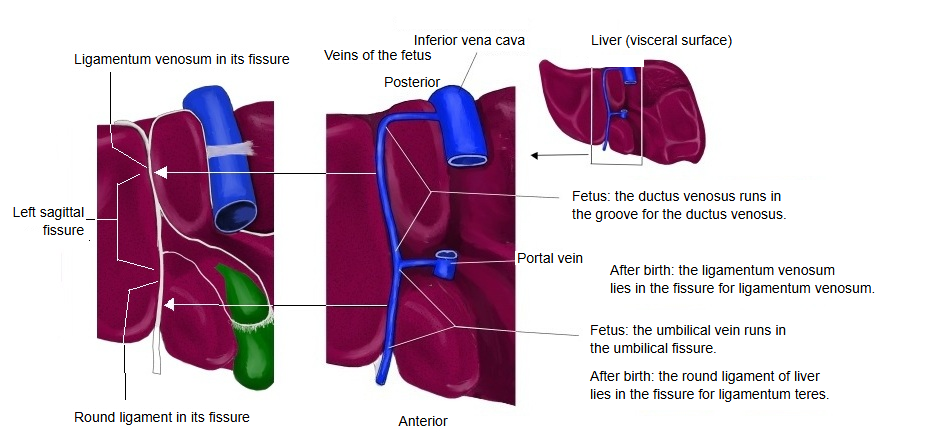
- Fissure for ligamentum teres : front part: the groove in which the round ligament of liver (fibrous remnant of the fetal umbilical vein) runs.
- Fissure for ligamentum venosum : back part: the groove in which the ligamentum venosum (fibrous remnant of the fetal ductus venosus) runs.
Note: some sources describe the left sagittal fossa as the fissure for the ligamentum teres + the left end of the porta hepatis + the fissure for the ligamentum venosum. The left sagittal fossa is the left limb of the H-shaped pattern on the visceral surface.
⇩
after
birth
- Umbilical vein ⇒ round ligament of liver : the umbilical vein (carrying oxygen-rich blood from the umbilicus to the liver) becomes a fibrous cord after birth: the round ligament of liver.
- Umbilical groove ⇒ fissure for ligamentum teres : the groove in which the umbilical vein ran becomes the fissure for the ligamentum teres.
- Ductus venosus ⇒ ligamentum venosum : the ductus venosus, the continuation of the umbilical vein, becomes a fibrous cord after birth: the ligamentum venosum.
- Groove for ductus venosus ⇒ fissure for ligamentum venosum : the groove in which the ductus venosus ran becomes the fissure for the ligamentum venosum.
· Before birth, the ductus venosus carries well-oxygenated blood from the umbilical vein straight to the inferior vena cava, so that much of it bypasses the liver tissue.
· The ductus venosus usually closes functionally within the first days after birth and becomes a fibrous cord over the following weeks (sources differ on the exact timing; in preterm infants it often takes longer). If it stays open, the condition is called a patent ductus venosus, a rare cause of a portosystemic shunt in infants.
 Liver: visceral surface
 Liver: lobes and structures
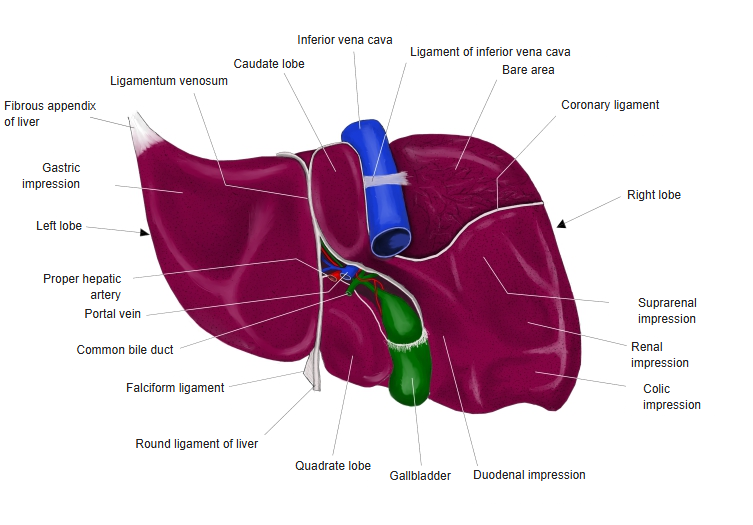
Where it is found
Related terms
- Fissure for ligamentum venosum
- Round ligament of liver
- Fissure for ligamentum teres
- Caudate lobe
- Porta hepatis
- Ductus venosus
- Liver
References and sources
- Further reading: Ligamentum venosum, Wikipedia.
- Further reading: Ductus venosus, Wikipedia.
- Federative International Programme for Anatomical Terminology (FIPAT). Terminologia Anatomica, 2nd ed. (TA2), 2019.