Foraminous spiral tract (Latin: tractus spiralis foraminosus)
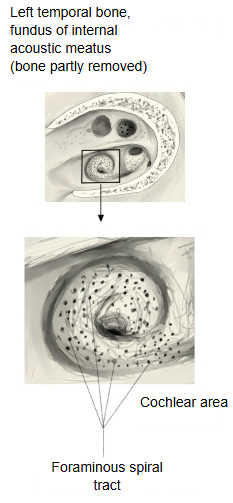
The tract lies in the front lower part of the fundus of the internal acoustic meatus, below the transverse crest, in the cochlear area. Its small holes wind in a spiral around a central opening, the entrance of the central canal of the modiolus. The holes lead into the longitudinal canals of the modiolus, which, with the central canal, carry the fibres of the cochlear nerve up to the spiral canal of the modiolus and the spiral ganglion. The spiral arrangement follows the turns of the cochlea: each part of the row serves a different part of the cochlear duct.
Reference websites
[Wikipedia]
· Internal auditory meatus, Wikipedia.
· Modiolus (cochlea), Wikipedia.
[Websites with illustrations]
· Cochlea cut open: modiolus and tractus spiralis foraminosus (slide) (SlideServe)

· Fundus of the internal acoustic meatus with the tractus spiralis foraminosus (figure) (Jaypee Brothers)

· Fundus of the internal acoustic meatus (drawing) (Springer)

Related terms
- Spiral ganglion
- Spiral limbus
- Spiral prominence
- Hamulus of spiral lamina
- Cochlear area
- Base of modiolus
- Modiolus
- Central canal of modiolus
- Spiral canal of modiolus
- Fundus of internal acoustic meatus
- Cochlear nerve
References and sources
- Further reading: Internal auditory meatus, Wikipedia.
- Further reading: Modiolus (cochlea), Wikipedia.
- Federative International Programme for Anatomical Terminology (FIPAT). Terminologia Anatomica, 2nd ed. (TA2), 2019.