Fovea of head of femur (Latin: fovea capitis femoris)
Also called the fovea capitis
A small oval pit on the head of femur, a little below (and behind) its centre, that is not covered with cartilage. It gives attachment to the ligament of head of femur.
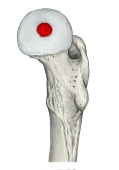 Right femur (upper end, medial)
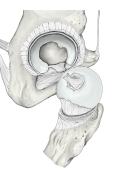 Right hip joint (opened)
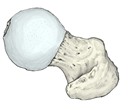 Right femur (upper end, from above)
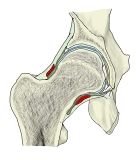 Right hip joint (coronal section)
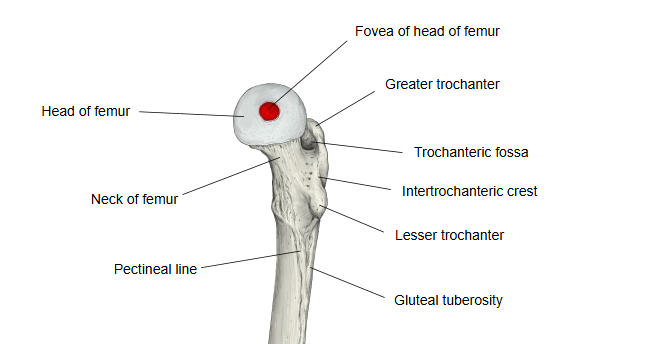
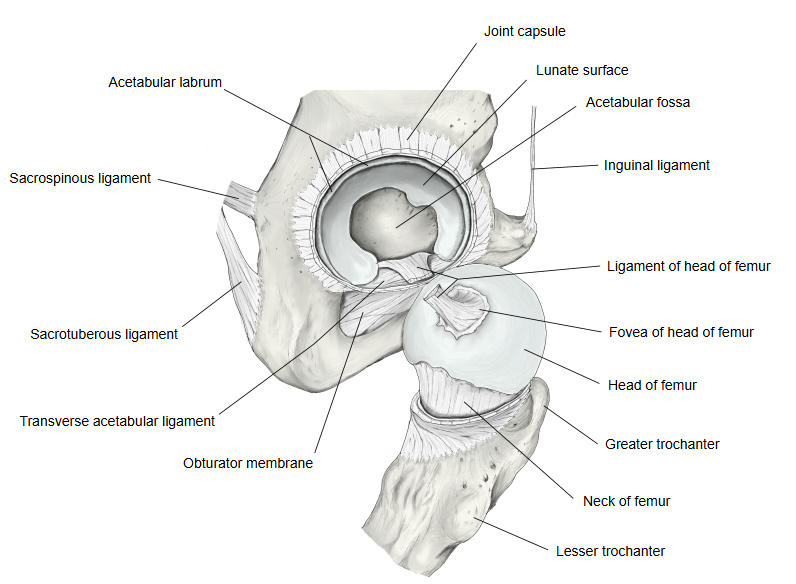
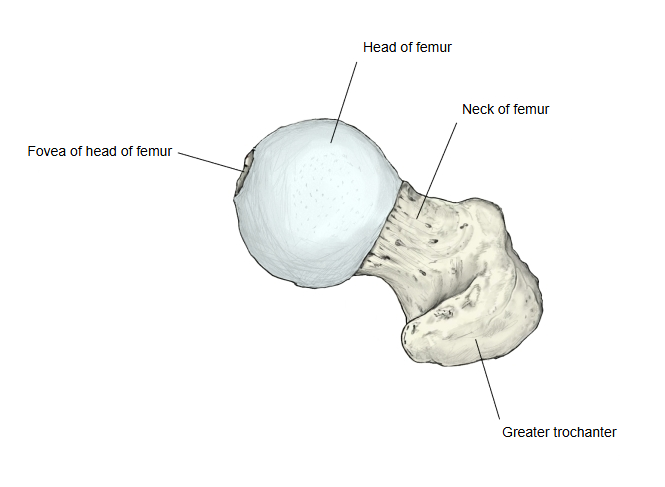
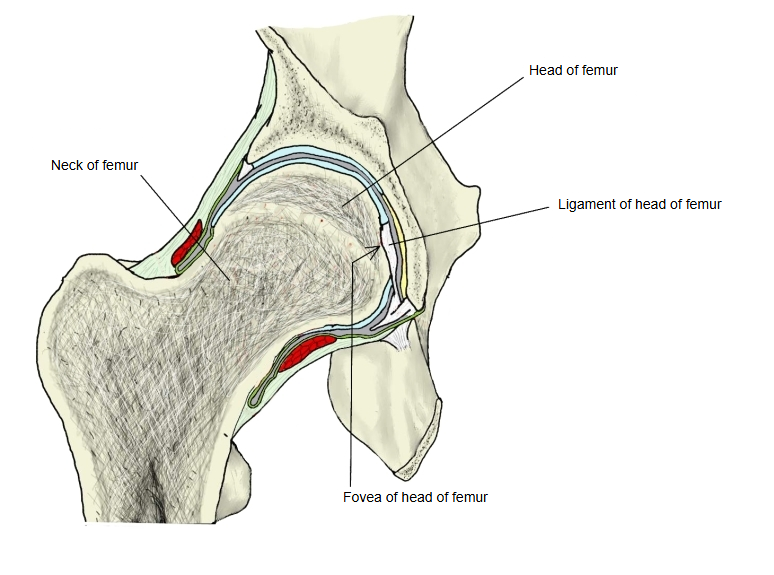
The surface of the head of the femur is smooth and, in the living body, covered with articular cartilage, except over this ovoid depression; it is the only part of the head without cartilage. The ligament of head of femur (ligamentum teres) runs from it to the acetabular fossa of the hip bone and the transverse acetabular ligament, inside the hip joint. The ligament carries a small artery (a branch of the obturator artery) to the head; it is important in children but contributes little in most adults.
Reference websites
[Wikipedia]
· Fovea capitis femoris, Wikipedia.
· Ligament of head of femur, Wikipedia.
[Websites with illustrations]
· Upper end of the femur, posterior view (photograph) (Wikimedia Commons)

· The hip joint (TeachMeAnatomy)
Where it is found
Related terms
References and sources
- Further reading: Fovea capitis femoris, Wikipedia.
- Further reading: Ligament of head of femur, Wikipedia.
- Federative International Programme for Anatomical Terminology (FIPAT). Terminologia Anatomica, 2nd ed. (TA2), 2019.