Groove for mastoid canaliculus
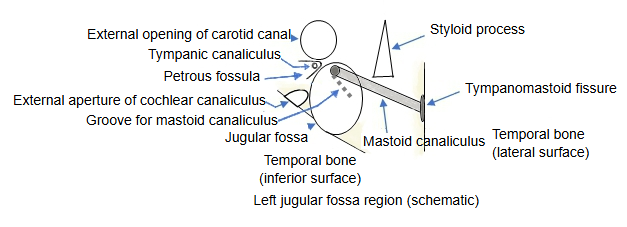
The groove for the mastoid canaliculus is a groove on the lateral side of the jugular fossa, on the inferior surface of the pyramid of the temporal bone; it soon enters the bone as the mastoid canaliculus.
Temporal bone: one of the bones of the neurocranium (8 bones of 6 kinds)Jugular fossa: the hollow that lodges the superior bulb of the internal jugular veinMastoid canaliculus: carries the auricular branch of the vagus nerve to the tympanomastoid fissure
· On the lateral side of the jugular fossa there is a fine groove for the mastoid canaliculus. It soon enters the bone as the mastoid canaliculus, which runs backwards and opens at the tympanomastoid fissure; it carries the auricular branch of the vagus nerve.
 Left temporal bone (inferior view)
 Left temporal bone (around the jugular fossa)
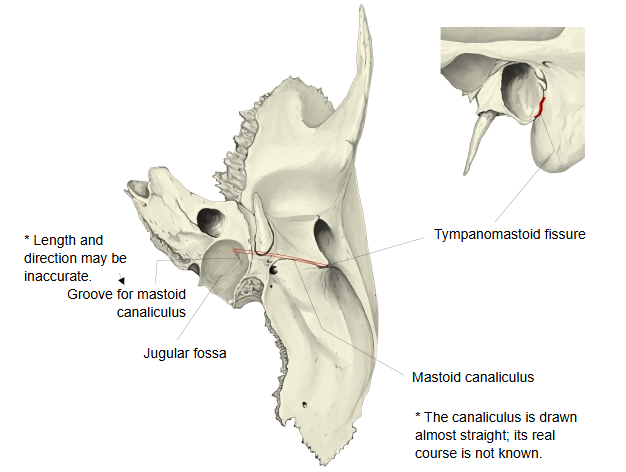
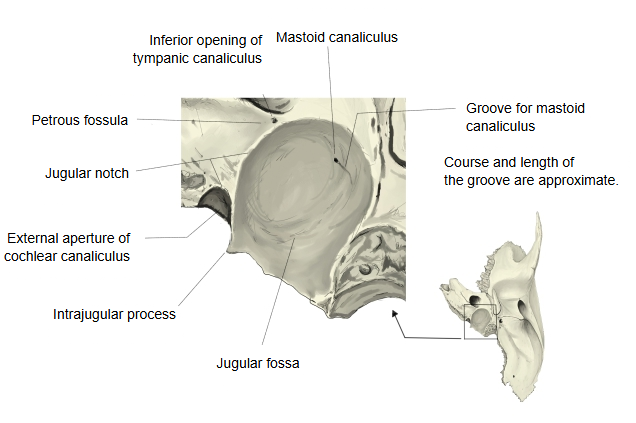
The mastoid canaliculus begins as the fine groove on the lateral wall of the jugular fossa, at once enters the bone and runs backwards to open at the tympanomastoid fissure; the groove and the canaliculus are the path of the auricular branch of the vagus nerve. The high ridge formed where the lateral wall of the jugular fossa meets the sheath of the styloid process marks the line where the tympanic part and the petrous part have fused.
Related terms
- Tympanomastoid fissure
- Petrous fossula
- Cochlear canaliculus
- Petrous part
- Tympanic part
- Sheath of styloid process
- Temporal bone
References and sources
- Further reading: Mastoid canaliculus, Wikipedia.
- Federative International Programme for Anatomical Terminology (FIPAT). Terminologia Anatomica, 2nd ed. (TA2), 2019.