Neurocranium (Latin: neurocranium)
Also called the braincase or cerebral cranium
The neurocranium is the part of the bones of the head (the skull) that encloses and protects the brain. It is also called the neural cranium or braincase.
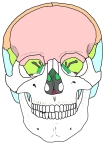 Skull (anterior)
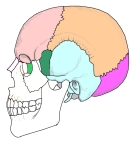 Skull (left lateral)
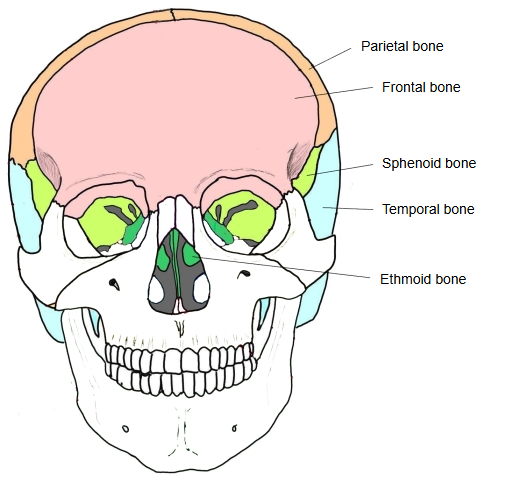
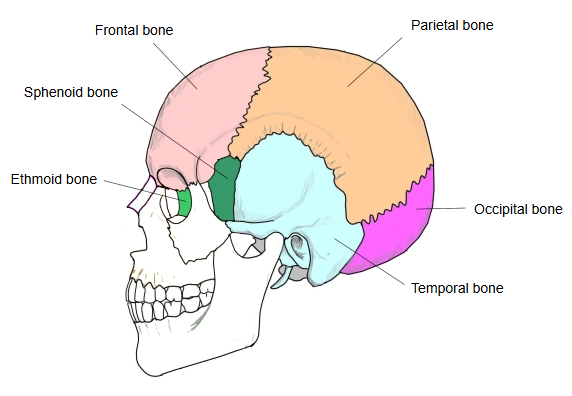
More details
The skull can be divided into two parts: the neurocranium, which holds the brain, and the viscerocranium (facial skeleton), which forms the face. The neurocranium is made up of 8 bones of 6 kinds.
The neurocranium has a domed roof, the calvaria, and a floor, the cranial base, which is pierced by many openings for nerves and vessels. The bones of the roof form directly in membrane, while most of the base forms first in cartilage. Sources differ on where the boundary between the neurocranium and the facial skeleton lies, and so on which bones (such as the ethmoid) are counted in each part.
The grouping below follows one standard anatomy textbook; anatomists differ somewhat in how they divide the bones between the two parts.
(15 kinds, 23 bones)
- Neurocranium (6 kinds, 8 bones) : also called the neural cranium
- Viscerocranium (9 kinds, 15 bones)
Bones of the neurocranium
| Neurocranium (6 kinds, 8 bones) | 1 | Frontal bone | os frontale | unpaired |
| 2 | Parietal bone | os parietale | paired | |
| 3 | Occipital bone | os occipitale | unpaired | |
| 4 | Temporal bone | os temporale | paired | |
| 5 | Sphenoid bone | os sphenoidale | unpaired | |
| 6 | Ethmoid bone | os ethmoidale | unpaired |
Related terms
References and sources
- Further reading: Neurocranium, Wikipedia.
- Federative International Programme for Anatomical Terminology (FIPAT). Terminologia Anatomica, 2nd ed. (TA2), 2019.