Hunter–Schreger bands
Also called the lines of Schreger or Schreger bands
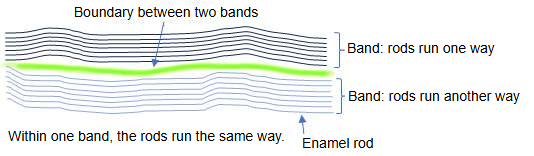
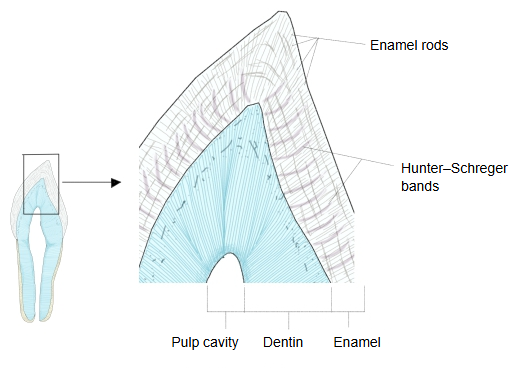
In a lengthwise section, groups of rods cut along their length alternate with groups cut across, so they reflect light differently and appear as light and dark bands. Some sources add that the two kinds of band differ slightly in mineral content; the exact explanation is debated.
The crossing of rod groups is thought to help stop cracks spreading through the enamel. The bands are not growth lines and are different from the striae of Retzius. The name "Schreger lines" is also used for curved lines in dentin formed by the bends of the dentinal tubules, so usage differs between sources.
Reference websites
[Wikipedia]
· Tooth enamel, Wikipedia.
[Websites with illustrations]
· Hunter–Schreger bands (figure) (Elsevier)

· Structure of enamel (figure) (British Dental Journal)

Related terms
References and sources
- Further reading: Tooth enamel, Wikipedia.
- Federative International Programme for Anatomical Terminology (FIPAT). Terminologia Anatomica, 2nd ed. (TA2), 2019.