Enamel rod
Also called Enamel prism
of enamel
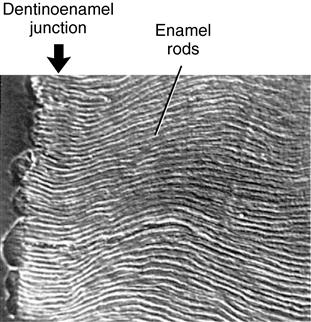
- Enamel rod : the main element of enamel: a bundle of hydroxyapatite crystals that runs closely packed, without branching, from the dentinoenamel junction to the surface of the crown
- Enamel sheath : the thin boundary layer around each rod, less mineralized and richer in organic matter
- Interprismatic substance : hydroxyapatite crystals that fill the narrow spaces between the rods (interrod enamel)
In ground longitudinal sections the course of the rods is not simple: at regular intervals groups of rods bend together, alternating with groups that run almost straight. Rods cut lengthwise and rods cut across reflect light and take up stains differently, so they form alternating light and dark bands, the Hunter–Schreger bands. Under the cusps the rods twist around each other (gnarled enamel), which helps the enamel resist chewing forces.
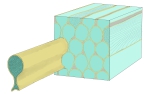 Enamel rods and their sheath
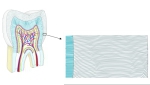 Course of enamel rods
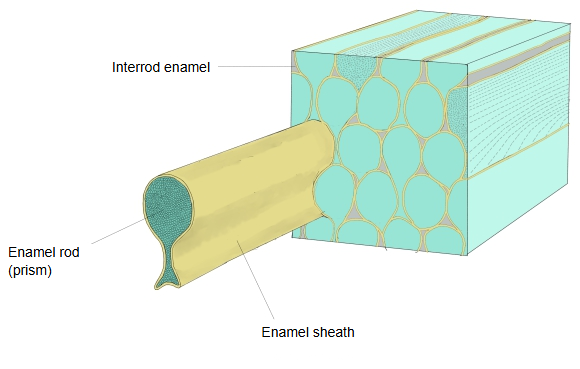
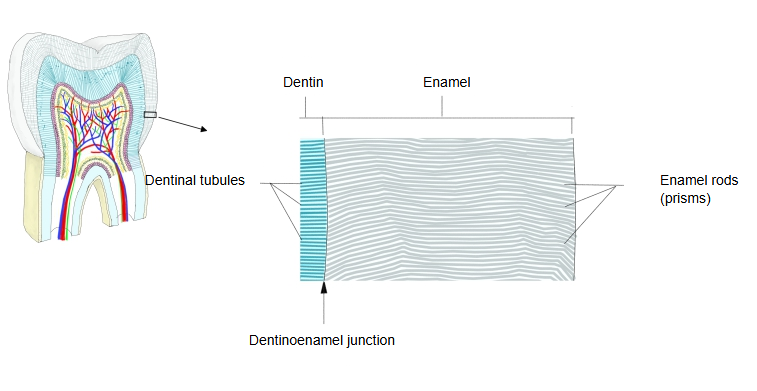
Each rod runs through the whole thickness of the enamel, and the narrow spaces between the rods are filled with hydroxyapatite crystals. The small amount of organic matrix left in mature enamel (proteins and some polysaccharide) is what remains of the matrix that the enamel-forming cells, the ameloblasts, secreted before the enamel mineralized. The part of a tooth covered with enamel is the anatomical crown, and the part exposed in the mouth is the clinical crown; the root is the part covered with cementum, and the part held in the tooth socket is the clinical root.
Reference websites
[Wikipedia]
· Tooth enamel, Wikipedia.
· Ameloblast, Wikipedia.
[Websites with illustrations]
· Enamel rods and rod sheaths (Pocket Dentistry)
· Enamel rods and interrod enamel (lecture slide) (Muhadharaty)

Related terms
- Enamel sheath
- Teeth
- Crown
- Dentinoenamel junction
- Cusp of tooth
- Interglobular dentin
- Intertubular dentin
References and sources
- Further reading: Tooth enamel, Wikipedia.
- Federative International Programme for Anatomical Terminology (FIPAT). Terminologia Anatomica, 2nd ed. (TA2), 2019.