Ileocecal valve (Latin: valva ileocaecalis)
Also called Ileocaecal valve or the ileocolic valve
- Overview
- Reference websites
- (Wikipedia, websites with illustrations)
- Where it is found
- Related terms
Overview
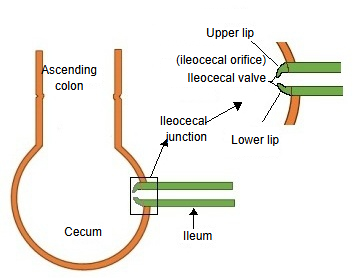
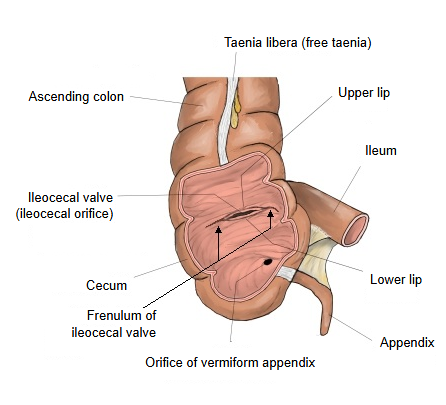
· It lies on the medial (left) side of the cecum, where the ileum joins the large intestine. At each end of the slit-like ileocecal orifice the two lips meet and continue as the frenula of the valve.
· The lips are formed by the mucosa and circular muscle of the ileum pushed into the cecum. The valve helps control the passage of contents into the cecum and limits backflow from the large intestine into the ileum; sources differ on how effective it is as a valve.
· Size varies a great deal between people; in adults it is roughly 2–4 cm wide and 1–2 cm high (rough estimate).
Reference websites
[Wikipedia]
· Ileocecal valve, Wikipedia.
[Websites with illustrations]
· Interior of the cecum showing the ileocecal (colic) valve (Gray's Anatomy) (Wikimedia Commons)

· The colon (TeachMeAnatomy)
· Large intestine (Kenhub)
Where it is found
Related terms
References and sources
- Further reading: Ileocecal valve, Wikipedia.
- Further reading: Cecum, Wikipedia.
- Federative International Programme for Anatomical Terminology (FIPAT). Terminologia Anatomica, 2nd ed. (TA2), 2019.