Colon (Latin: colon)
- Overview
- Features of each part of the colon (size, mobility and function, relation to the peritoneum)
- Nerves and vessels
- Related terms
- References
Overview
The colon is a part of the large intestine and consists of four parts: the ascending colon, transverse colon, descending colon and sigmoid colon.
Part of the digestive tract; its main work is absorbing water and salts
For details, see the description of each part.
Parts of
the colon
the colon
- Ascending colon : length 20–25 cm; work: vigorous absorption of water, fermentation; contents: liquid to mushy.
- Transverse colon : length 40–60 cm; work: continued absorption, transport; contents: mushy to soft solid.
- Descending colon : length 20–30 cm; work: passage of faeces (transport); contents: semi-solid.
- Sigmoid colon : length 30–40 cm; work: temporary storage, preparation for defecation; contents: solid.
Teeth; salivary glands → salivaSmall intestine: duodenum, jejunum, ileum. Liver → bile → gallbladder; pancreas → pancreatic juice (both into the duodenum)Large intestine: cecum, colon, rectum
Parts of the
large intestine
large intestine
- Cecum : length 6–9 cm; the beginning of the large intestine; temporarily stores the contents from the small intestine.
- Vermiform appendix : a tube about 6–10 cm long; helps to keep the balance of the gut bacteria and takes part in immune function.
- Colon : the main part of the large intestine; functions: absorption of water and electrolytes, storage and transport of faeces. Parts: ascending colon (20–25 cm), transverse colon (40–60 cm), descending colon (20–30 cm), sigmoid colon (30–40 cm).
- Rectum : length 12–15 cm; stores faeces temporarily and passes them to the anal canal for defecation.
- Anal canal : length 3–4 cm; the last part of the digestive tract; faeces are expelled through its end, the anus.
For a detailed description, see the page of each part.
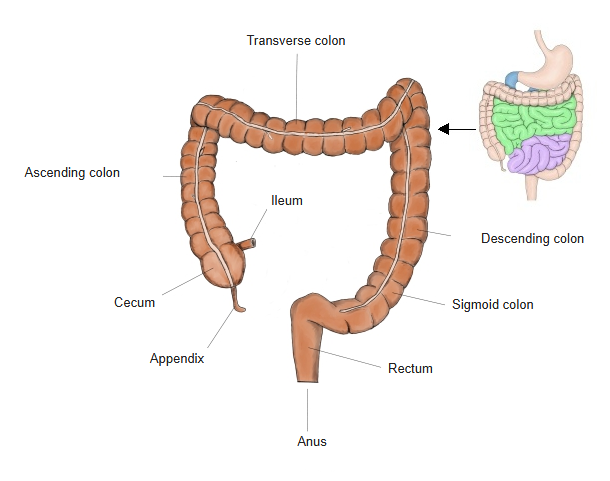
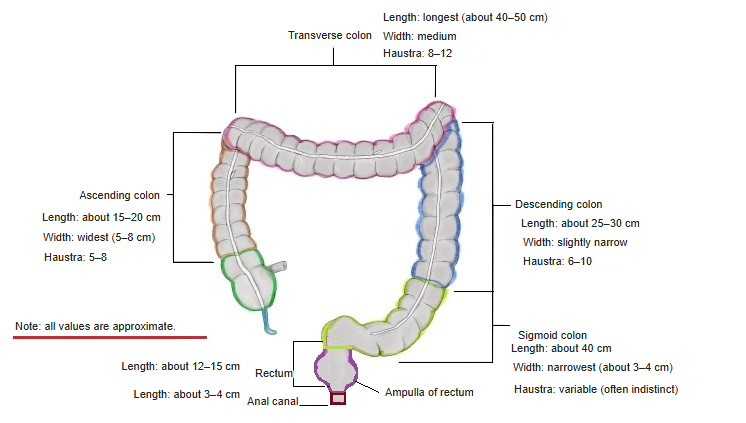
Features of each part of the colon
The features of each part of the colon are summarised briefly in the tables below, item by item.
■ Size ■ (the figures are only a guide; lengths differ between sources)
| Item | Ascending colon | Transverse colon | Descending colon | Sigmoid colon |
|---|---|---|---|---|
| Length | about 15–20 cm | about 40–50 cm | about 25–30 cm | about 40 cm |
| Width | widest (about 5–8 cm) | medium | slightly narrow | narrowest (about 3–4 cm) |
| Haustra | 5–8 | 8–12 | 6–10 | variable (often indistinct) |
■ Mobility, wall and function ■
| Item | Ascending colon | Transverse colon | Descending colon | Sigmoid colon |
|---|---|---|---|---|
| Mobility | none (fixed to the back by the peritoneum) | high (transverse mesocolon) | fixed (retroperitoneal) | very high (sigmoid mesocolon) |
| Wall | mucosa and muscle layer as in the other parts | has a mesentery and is covered by serosa | mucosa and muscle layer as in the other parts | thick wall with strong contractions |
| Main work | absorption of water and electrolytes | absorption of water, transport of faeces | storage and transport of faeces | storage of faeces, preparation for defecation |
| Contents | liquid to semi-fluid | semi-fluid to mushy | solid (faeces) | solid (faeces) |
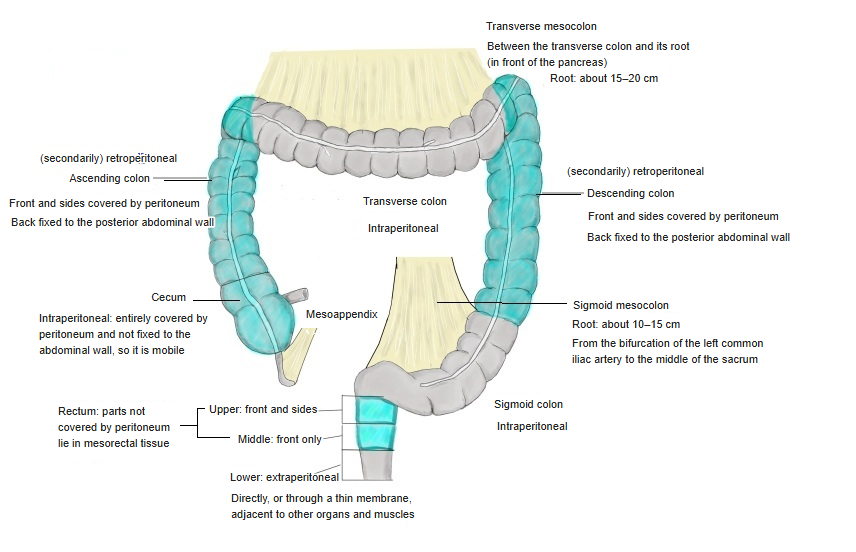
[Relation to the peritoneum]
| Item | Ascending colon | Transverse colon | Descending colon | Sigmoid colon |
|---|---|---|---|---|
| Peritoneal class | (secondarily) retroperitoneal organ | intraperitoneal organ | (secondarily) retroperitoneal organ | intraperitoneal organ |
| Covering by peritoneum | front and sides only | all round | front and sides only | all round |
| Mesentery | none (fused to the posterior abdominal wall) | present (transverse mesocolon) | none (fused to the posterior abdominal wall) | present (sigmoid mesocolon) |
| Mobility | low (fixed) | high | low (fixed) | very high |
| Neighbours | near the right kidney and the duodenum | near the stomach, pancreas and liver | near the left kidney | near the urinary bladder, the uterus / rectum |
[Nerves, vessels and lymphatics]
| Part | Embryonic origin | Arteries | Veins | Lymph nodes (main) | Nerves (autonomic) |
|---|---|---|---|---|---|
| Ascending colon | midgut | superior mesenteric artery (right colic artery) | superior mesenteric vein | superior mesenteric lymph nodes | sympathetic: thoracic splanchnic nerves; parasympathetic: vagus nerve |
| Transverse colon | midgut / hindgut | superior / inferior mesenteric artery (middle colic / left colic artery) | superior / inferior mesenteric vein | superior / inferior mesenteric lymph nodes | parasympathetic: vagus nerve / pelvic splanchnic nerves; sympathetic: thoracic / lumbar splanchnic nerves |
| Descending colon | hindgut | inferior mesenteric artery (left colic artery) | inferior mesenteric vein | inferior mesenteric lymph nodes | parasympathetic: pelvic splanchnic nerves; sympathetic: lumbar splanchnic nerves |
| Sigmoid colon | hindgut | inferior mesenteric artery (sigmoid arteries) | inferior mesenteric vein | inferior mesenteric lymph nodes | parasympathetic: pelvic splanchnic nerves; sympathetic: lumbar splanchnic nerves |
Related terms
Main anatomical terms related to the colon, in alphabetical order.
References and sources
- Further reading: Colon (anatomy), Wikipedia.