Ileum (Latin: ileum)
- Overview
- Differences between the jejunum and ileum (Peyer's patches, circular folds, villi, others)
- Jejunum and ileum compared
- Related terms
- References
Overview
- Respiratory system
- Digestive system : oral cavity, pharynx, esophagus, stomach, small intestine, large intestine
- Urinary system
- Genital system
- Peritoneum
- Endocrine glands
· The length of the jejunum and ileum differs greatly between the living body and the cadaver: about 2–3 m in life and up to 6–7 m after death, mainly because muscle tone is lost and the intestine is stretched by gravity and handling.
· In their natural winding course in the abdominal cavity, the jejunum lies mostly in the umbilical region, the lower abdomen and the left iliac fossa, and the ileum in the greater pelvis, the lower abdomen and the right iliac fossa.
small intestine
- Duodenum : C-shaped tube (about 25–30 cm) continuing from the stomach; receives pancreatic juice and bile.
- Jejunum : continues from the duodenum and forms the upper 2/5 of the small intestine beyond it; the main site of absorption of the (three major) nutrients.
- Ileum : the last part of the small intestine (the lower 3/5); absorbs the nutrients not absorbed in the jejunum.
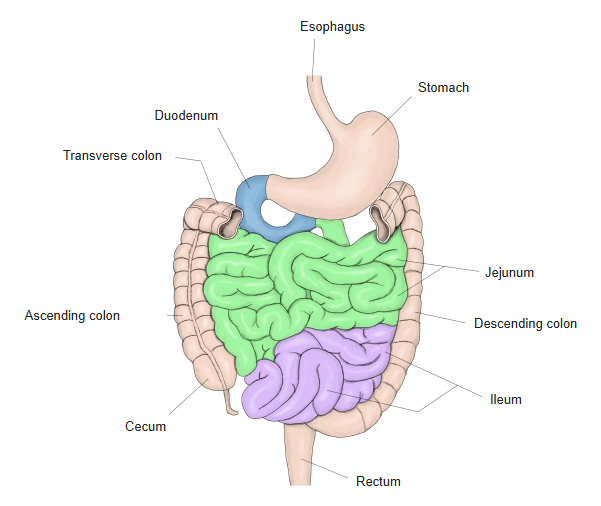
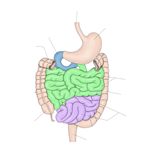 Duodenum, jejunum and ileum
Differences between the jejunum and ileum
There is no clear border between the jejunum and the ileum, and they have much in common, so this section describes only how they differ. For the structure of the wall, the vessels, the nerves and so on, see the jejunum.
[Peyer's patches]
[Circular folds]
| Jejunum: the main site of digestion and absorption | Ileum: the rest, and special substances |
Mainly absorbed in the jejunum: · Sugars (glucose, galactose and others) · Amino acids, peptides · Fatty acids, monoglycerides · Vitamins (water-soluble and fat-soluble) · Water and electrolytes (water absorption is most active in the jejunum) · Others: iron, calcium | Mainly absorbed in the ileum: · Vitamin B12 (absorbed only in the terminal ileum, as a complex with intrinsic factor) · Bile acids (reabsorbed in the terminal ileum and returned to the liver) · The remaining fats · Water and electrolytes (sodium absorption somewhat predominant) |
[Villi]
[Others]
· The intestinal wall is thinner than that of the jejunum.
· There is more fat in the mesentery.
· The arteries (ileal arteries) form more anastomoses (arcades).
· Mucosa: the jejunum looks redder, while the ileum is less red, a pale pink (because of differences in blood flow and in the distribution of lymphoid tissue).
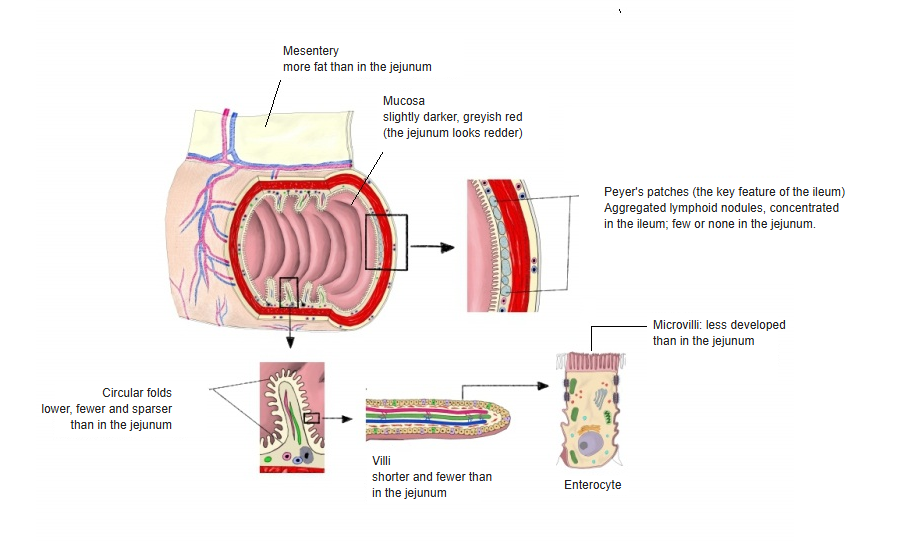
Jejunum and ileum compared
[Diameters]
| Part | Outer diameter (cm) | Inner diameter (cm) | Notes | |
| Jejunum | Upper (proximal) | about 3.0–3.5 | about 2.5–3.0 | The widest part; the circular folds are well developed. |
| Lower (distal) | about 2.8–3.2 | about 2.3–2.8 | Gradually narrower. | |
| Ileum | Middle | about 2.5–2.8 | about 2.0–2.5 | Lymphoid tissue (Peyer's patches) increases. |
| Terminal | about 2.0–2.5 | about 1.5–2.0 | The narrowest part; continues to the ileocecal valve. | |
· The values are approximate.
[Absorption]
| Item | Jejunum | Ileum | |
| 1 | Main role | Main absorption of nutrients | Absorption of special substances + the rest |
| 2 | Efficiency | Very high | Lower than in the jejunum |
| 3 | Substances absorbed | Sugars, amino acids, fats, water, electrolytes, Ca, Fe | Vitamin B12, bile acids, Na, the remaining nutrients |
| 4 | Tissue features | Tall villi, many folds | Lower villi, many Peyer's patches |
| 5 | Transport mechanisms | Varied and numerous | Special transporters (vitamin B12, bile acids) |
[Summary]
| Item | Jejunum | Ileum | |
| 1 | Position | Upper part of the small intestine, continuing from the duodenum | Lower part of the small intestine, continuing from the jejunum to the cecum |
| 2 | Length | About 2/5 of the jejunum and ileum | About 3/5 |
| 3 | Wall | Thick | Thin |
| 4 | Blood vessels | Rich (larger vessels forming a few arcades, long vasa recta) | Fewer (smaller vessels forming many arcades, short vasa recta) |
| 5 | Fat | Little fat in the mesentery | Much fat in the mesentery, reaching close to the intestine |
| 6 | Folds | High, dense and well developed | Low and sparse; almost absent at the end |
| 7 | Lymphoid tissue | Mainly solitary lymphoid nodules | Many Peyer's patches (aggregated lymphoid nodules) |
| 8 | Colour | Redder | Pale pink |
Related terms
Main anatomical terms related to the ileum, in alphabetical order.
| A | Aggregated lymphoid nodules |
| C | Circular folds |
| I | Ileal arteries, Ileocecal valve |
| M | Mesentery |
| P | Peyer's patches |
| V | Villi |
References and sources
- Further reading: Ileum, Wikipedia.